Saturday, March 17, 2018

"Women's Suffrage: "Remember the Ladies"


In 1848, 300 women and men, including Frederick Douglass, gathered in Seneca Falls, New York to sign the Declaration of Sentiments, a document regarding the end of discrimination against women in every aspect of society. Colonial law was based on English common law that merged man and woman into one individual upon marriage and women had no legal standing separate and apart over her property or finances. By 1777, women had lost the right to vote in every state.

The road to the August 26, 1920 ratification of the Nineteenth Amendment was a long, difficult and circuitous one. It is best traced at sites in the state of New York and includes women of all ethnicities. It declares, “The right of citizens of the United States to vote shall not be denied or abridged by the United States or by any State on account of sex.”(www.iloveny.com).

Women’s Rights National History Park Visitors Center
Many of the people involved in the women’s rights movement were previously staunch abolitionists and civil rights advocates. At the conclusion of the Civil War and the 1870 passage of the 15th Amendment declaring, “The right of citizens of the United States to vote shall not be denied or abridged by the United States or by any State on account of race, color, or previous condition of servitude,” many women felt let down by their exclusion and began to protest vehemently for women’s rights. They used the organizational, fundraising and speaking skills learned as abolitionists.

It should be noted that as early as 1776, Abigail Adams wrote to John Adams during Philadelphia’s Continental Congress to, “Remember the Ladies.” In 1851, former slave Sojourner Truth, speaking at an Ohio women’s rights convention, gave her famous “Ain’t I a Woman?” speech. (www.sourcebooks.fordham.edu/mod/sojtruth-woman).

In the 1830s, abolitionist organizations and the Underground Railroad were prevalent in Syracuse in Onondaga County. More than 650 African-Americans lived in the county. Along with their White counterparts, they actively spirited people to Canada. (www.pacny.net/freedom_trail).
The museum of the Onondaga Historical Association has an outstanding, interactive exhibit on the UGRR that introduces visitors to the personal stories through artifacts, exhibits and video. An exhibit on the 1851 Jerry Rescue relates the story of the rescue of fugitive William “Jerry” Henry from slave catchers by a crowd of citizens.

Women’s Rights National History Park Visitors Center interior
The Jerry Rescue Monument on Clinton Square is a life-sized bronze depiction of the incident. It faces north toward Canada where Henry made his eventual escape. The history of the  Native American inhabitants and their influence on the nation is also depicted in a permanent exhibit. (www.cnyhistory.org).

Matilda Joslyn Gage is the unsung hero of the women’s rights movement. Her father was an abolitionist and her home was an UGRR station. Her stance on the rights of women was modeled on her close interactions with the matriarchal Haudenosaunee Indians living in the area. Ultimately, she was considered too radical for Stanton and Anthony.

A 15-minute film introduces a self-guided tour. Each room on the tour is based on one of her social justice themes. The front parlor is dedicated to the works of her son-in-law, Frank Baum, author of “the Wizard of Oz.” We can see her influence on the character of Dorothy. Her home is included on the National Underground Railroad Network to Freedom. (www.matildajoslyngage.org).


Ganandagon nomination belt
Ganondagan, State Historic Park, is the state-of-the-art home of the Seneca Art and Culture Center situated on the site where the Seneca and Haudenosaunee established the “Town of Peace.” Visitors can explore a replica Bark Longhouse, self-guided trails, videos and a unique museum.
The museum interprets the story of the six nation Haudenosaunee Confederacy, Mohawk, Oneida, Onondaga, Cayuga, Seneca and Tuscarora, that inspired the Constitution and the 1848 Declaration of Sentiments. Their symbol, bundled arrows stronger than one, is depicted on the Great Seal of the United States. (www.ganondagan.org).

Seneca Falls is renowned as the cradle of women’s rights. The first convention was organized by abolitionists Elizabeth C. Stanton and Philadelphia’s Lucretia Mott and held there in 1848 at the Wesleyan Chapel. Stanton lived in Seneca Falls along with her husband and seven children and her house is open daily. (www.senecafalls.com).


Women’s Rights National Historical Park is adjacent to the chapel and is an ideal place to begin a tour. An orientation film, “Dreams of Equality” and an exhibit gallery enhance your visit. Also, on display is memorabilia from “12 Years a Slave.” The lobby’s bronze “First Wave” sculpture consists of life-sized figures of some of those in attendance at the first convention including Douglass.

The National Women’s Hall of Fame was founded in 1969.  Since that time 276 women in the arts, athletics, business, education, government, humanities and philanthropy have been inducted. The NWHF will be moving to the 1844 Seneca Knitting Mill because a larger space is needed. I encourage you to visit their website where you can view photographs, learn the stories and hear their voices. (www.womenofthehall.org).

“It’s a Wonderful Life” is one of world’s favorite movies.  It is believed that Frank Capra, after visiting Seneca Falls, modeled the mythical Bedford Falls after the city. The “It’s a Wonderful Life Museum” is filled with memorabilia, photographs, toys and documents that relate to the stars, their characters and the movie. The tragedy of Antonio Varacalli probably inspired George’s scene on the bridge and you can learn the true story here. (www.therealbedfordfalls.com).


The Susan B. Anthony House & Museum is located in Rochester.
She lived in this 12-room brick house from 1866-1906. Tours of the house include her 3rd-floor workroom and the room in which she died in 1906. Ida Wells-Barnett was known to stay there when in Rochester. Anthony is buried in Mount Hope Cemetery. (www.susanbanthonyhouse.org).

The boutique Gould Hotel is newly renovated and offers luxurious accommodations, exemplary service, an on-site restaurant, free parking and complimentary WIFI. Best of all, it is located in the heart of Seneca Falls and within walking distance of the major sites. (www.thegouldhotel.com).


For current research on African-American women leaders in the suffrage movement, go to www.suffragistmemorial.org/african-american-women-leaders-in-the-suffrage-movement.


Bad Romance - Women's Suffrage (Inspired by Alice Paul) - YouTube

Sunday, March 11, 2018

Motives of Peace: Douglass in Rochester


          In 1926 Carter G. Woodson created Negro History Week and deemed February the month for this celebration of black achievement because it was the birth month of both Frederick Douglass and Abraham Lincoln. Douglass, the most photographed man of his era, was also the most influential man of color.
          He was born, Frederick Augustus Washington Bailey, enslaved in the Eastern Shore, in 1818. He "stole himself" on September 3, 1838 and traveled by train and boat to Philadelphia and then New York. He changed his name to Douglass in New York and wed Anna Murray-Douglass, a free Baltimorean who had assisted his escape. Douglass moved to Massachusetts, became involved in the abolitionist movement and rapidly became an important orator. He had learned of the movement in 1831, shortly after he became literate, when he came upon a copy of the Columbian Orator.

           In 1847 Douglass relocated to Rochester, New York after a rift developed between Douglass and his mentor citing "motives of peace". His family joined him in 1848. Douglass chose Rochester for several reasons. New York State played a significant role in the Underground Railroad (UGRR) because it offered Canadian access via land and water. There were more active anti-slavery groups in the state than in any other and religious and black communities provided assistance and a haven. He also had a number of friends in the city. Douglass would live there until 1872, longer than he would reside anywhere else. www.visitrochester.com
Douglass was not the first person of African descent to live in Rochester albeit he is the most renowned. Asa Dunbar, a mulatto, was among the first to settle the area in 1795. Within 30-years the number of blacks had grown to over 230 largely due to jobs available in the mills and the canal industry.
         Southern slave catchers would sometimes track freedom seekers to Rochester and there are regional stories of the community assisting in escapes. One of the most poignant of these stories deals with Ellen who was tracked and captured. The black community managed to free her but she was recaptured. The second capture resulted in her gaining her freedom by slitting her own throat.

The city of Rochester is honoring the legacy of Douglass on the 200th anniversary of his birth. A series of creative and informative events will take place throughout the year spearheaded by the city and the Frederick Douglass Bicentennial Commemoration Committee under the aegis of Rochester Community Television and Rochester Contemporary Art Center.  A proclamation designating 2018 as "The Year of Frederick Douglass" was decreed on Jan. 4th. www.cityofrochester.gov/frederickdouglass200

Douglass began publication of the 4-page weekly newspaper The North Star. The first issue was published in the basement of the A.M.E. Zion Church, an UGRR stop, on December 3, 1847 at a cost of $2.00 annually. Subsequently it was published in the Tallman Building until 1851. In 1851 it became Frederick Douglass' Paper and 1861-1863 as the Douglass' Monthly.
         The Tallman Building was constructed in 1820. During Douglass residence the building served as a stop on the UGRR and it is believed that he hid freedom seekers in his printing office. In 1849 Harriett Jacobs organized an anti-slavery reading room there. The building has been designated a Historic Site in Journalism.
           Douglass purchased a home in 1848 at 4 Alexander Street from an abolitionist. His neighbors on both sides were abolitionists. Even though there were protests by other residents he lived there for 4-years. He then moved just outside the city. This rural home served as a stop on the UGRR with Anna often serving as stationmaster.
           On May 22, 1863 the Bureau of United States Colored Troops (USTC) was formed by the War Department. Douglass immediately became a recruiter and two of his first recruits were his sons Lewis and Charles.
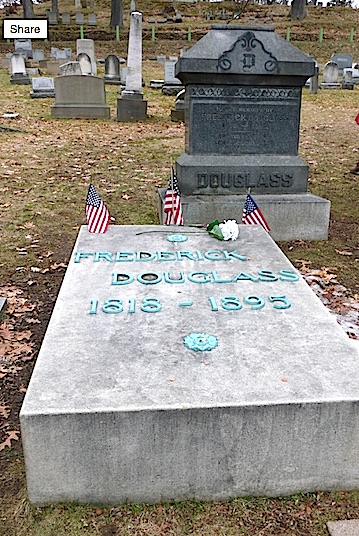
            In 1872 Douglass home was burned down in a probable case of arson. He returned from a speaking engagement to find his home gone, his family displaced and he was refused a hotel room until they learned who he was. He then moved to Washington, DC where he died of a heart attack in 1895. A second funeral was held for him at Central Presbyterian Church in Rochester and he was interred in Mount Hope Cemetery. www.fomh.org

            Rochester Museum & Science Center's exhibit, Flight to Freedom: Rochester's Underground Railroad, is an outstanding interactive journey in the footsteps of historic abolitionists and freedom seekers. Special emphasis is placed on the lives of Douglass and Harriet Jacobs. This exhibit is a learning experience for all ages. www.rmsc.org

         Rochester Contemporary Art Center's unique exhibition runs until March 18th. No Soil Better: Art and the Living Legacy of Frederick Douglass is comprised of works by ten artists who, employing modern techniques and contemporary sensibilities, visually revisit Douglass' life and legacy. www.rochestercontemporary.org

Douglass was a good friend of Susan B. Anthony and a supporter of the Women's Movement. Let's Have Tea, sculpted by Pepsy M. Kettavong, depicts Anthony and Douglass doing just that in Susan B. Anthony Square Park. www.susanbanthonyhouse.org
Sidney W. Edwards' 1899 Douglass Monument is located Highland Park. Originally situated near the train station, it was relocated in 1941. It was the first statue dedicated to an African American in the country.
         The Strathallan Hotel is a Rochester icon. This premier boutique hotel offers an extensive menu ofservices including luxurious accommodations, superior service, spa and a rooftop bar with a 360-degree city view. Situated in the heart of the city, it is walking distance to many attractions. The Strath is a great choice when visiting the city. www.strathallan.com

              Honor his legacy by seeking the spirit of Douglass in Rochester. www.iloveny.com

Travel Tips:
Seat sitters are the perfect inexpensive protection for travelers. The package contains 1 seat cover, 1 tray table cover, 1 allergy mask and 2 sanitary wipes. These items, while disposable, can also be washed and recycled. Protect yourself and your loved ones from food allergies, E-Coli, Cold and Flu germs and accidental spills. www.SeatSitters.com

Bank & Bourbon Hosts 4th Annual Bourbon Bash


On Tuesday, April 17, 2018  Executive Chef Thomas Harkins will be preparing some of his signature dishes including Corn Cakes with Tomato Marmalade, Beer Tartar on Crispy Fingerling Potato and Crab Fritters with Spicy Remoulade along with multiple carving stations and accompanying Bourbon and multiple beverage stations featuring signature cocktails and a Single Barrel Tasting Bar from Flavor Philadelphia partner, Saint Benjamin Brewing Company. 

Proceeds from ticket purchases will go towards DonorsChoose.org, an organization that supports educational needs and programs in the Tri-State area. Local teachers and more than 15,000 pupils have benefitted from donations exceeding $50,000 in contributions from the past three events.
Tickets and sponsorship opportunities are available.

Bank & Bourbon
1200 Market Street
Tuesday, April 17
6:00 p.m. – 9:00 p.m.

#BourbonBash2018
@bankandbourbon
@LoewsPhiladelphia
www.donorschoose.org