Tuesday, October 3, 2023

Wichita, Kansas, Meet the Legendary


“All things are bound together. All things connect."  Chief Seattle, Duwamish


                  Wichita’s iconic symbol, The Keeper of the Plains, sums up the overarching history, culture, significance and role of the city where the West truly begins. The 44-foot Keeper of the Plains is situated at the site where the Big and Little Arkansas Rivers, in downtown Wichita, is on Native American sacred ground. It faces the rising sun, weighs 5-tons and stands on a 30-foot pedestal and is depicted with arms lifted in entreaty to the Great Spirit. A “Ring of Fire” burns all year on a regular schedule. The sculpture’s design was created and gifted to the city by Kiowa-Comanche artist Blackbear Bosin in 1974.

                  Keeper Plaza features cultural information on the Plains Indians. Around the statue are multiple plaques describing the life, belief, and practices of pre-contact Plains Indian tribes. A sacred hoop symbolizes the directions, the seasons and the earth’s essential elements earth, wind, fire and water. The earliest inhabitants lived on the Great Plains for more than 14,000-years. These tribes included the Blackfoot, Cheyenne, Comanche, Crow and Sioux. Their lives were largely nomadic and revolved around the buffalo. Native Americans continue to gather at this sacred site.


                  In 1969 the Mid-America All-Indian Museum was established as a keeper and promulgator of American Indian culture and heritage. Seventy-three tribes are represented in the Wichita region. The museum has a 3,000-piece collection and presents rotating exhibits. An Outdoor Learning Center featuring a 20-ft tall tipi and a classroom enhance the complex. Galleries incorporate unique artifacts, video and immersive activities. Theindianmuseum.org

                  In 1865 Jesse Chisholm, Scottish-Cherokee trader, blazed a trade route that would evolve into the Chisholm Trail, from Texas to Wichita. The trail was used for cattle drives from the 1860s to the 1870s for cattle headed for northern railheads. Wichita thrived on the cattle trade and constructed hotels and two infamous saloons, the First and Last Chance, one at each end of the route. The railroad came to Wichita in 1872 ending an era.


                  Old Cowtown Museum, established in 1950, maintains the history and legacy of the more profane aspects of the town. The museum has 54 buildings in 45 exhibit spaces in five dedicated districts, Old Town, Business, Agricultural, industrial and Residential. Buildings date from the 1800s and many are original. Tours of the town allow visitors to immerse themselves in the 1870s through stagecoach rides, reenactments, gunfights and demonstrations. The DeVore Farm is particularly interesting in its depiction of life on a working farm post-Civil War. This is a Wichita must. oldcowtown.org

                  In the city center you will find Old Town. The ambiance of its brick streets is created by street lamps and converted brick warehouses. Stores and dining venues make this a great place for an evening stroll.

                  Known as The Great American Desert, Kansas’ Indian Territory, basically isolated from the people of European descent yet relatively near slave-holding states, it appeared to be an ideal place for African Americans to settle. Battles were fought until the 1850s to determine whether the land would be slave of free. The population of enslaved in 1860 was 2 and 625 free blacks. Post-Civil War black organizations formed groups to settle in Kansas. In 1879 the Exoduster Movement began and by the end of the movement more than 41,000 African Americans had resettled in the state.


                  The Kansas African American Museum is a repository for the history and contributions that make up the African American experience in the West. Calvary Baptist Church was erected in 1917 by the congregants during the hours after work. Calvary relocated in the 70s, was purchased by the First National Historical Society and became the Kansas African American Museum in 1998. Renowned artist Dr. Samella Lewis donated a portion of her personal art collection as a foundation for the museum’s permanent collection. The holdings include works by Barthé, Bearden, Catlett and Gordon Parks as well as African galleries. Tkaamuseum.org


                  A little further afield Kansas showcases its heritage in unique and interesting ways. The iconic sunflower is showcased at the Kansas Maze Sunflower Field. The field is more than 16-acres and provides endless photo opportunities. kansasmaze.com


                  Lazy Moon Ranch is an eccentric and whimsical site that brings guests in contact with animals and art. The ranch features Miniature Donkeys, alpacas, Dwarf Nigerian Goats and other farm animals. Guests can arrange for an art lesson to create a personal souvenir of the visit. The Lazy Moon is available for event rental. lmoonranch.com

                  Envisions Art Gallery is totally unique in the country. In 2022 it opened with programming designed for the blind, visually impaired and disabled artists and visitors. The gallery features inclusive classes, tactile art exhibits and QR codes and braille access, with author’s name and the title of to each piece. White guidelines lead those with medical devices on an easy tour of the gallery. Exhibits rotate on a regular basis and the artists benefit financially from all sales. @envisionus.com 


                  Tanganyika Wildlife Park began with the boyhood dream of Jim Fouts of working with animals. He became a keeper in 1972 and in 1985 he purchased land and constructed a barn as the foundation of his wildlife park. In 1987 he acquired 2 tigers and began breeding animals. He and his family then constructed a state-of-the-art complex with private funds. Tanganyika opened in 2008. It is now one of the largest privately owned zoos in the country. They now have more than 40 exhibit areas, greater than 10 interactive stations, 37 different breeding programs and more than 500 animals. Visitors are invited to get up close and personal with the animals. The facility is available for event rental. Here you really can talk with the animals. twpark.com


                  Wichita has more than 50 museums and attractions and 1,200 places to dine. Spend some time in legendary places. #VisitWichita. #KSmediaevent2023 

Saturday, September 30, 2023

Autumn in Dutchess County, New Yor

“All that is within me cries out to go back to my home on the Hudson River.”  FDR

On September 2, 1609 the Halve Maen (Half Moon), captained by Henry Hudson, moored in New York Harbor and for 35-days he and his 16-man crew explored the region. He was seeking a northern passageway to Asia for the Dutch East India Company. During his New York explorations he claimed the area for the Dutch and sailed up the 315-mile Hudson River (Muhhekunnetuk) noting its fertility, beauty and natural resources. Hudson’s overall journey was considered a failure resulting in a mutinous crew and in 1611 he, his son and 7 crewmen were set adrift aboard a boat. Their fate remains unknown. #Iloveny

Hudson’s explorations did lead to the founding of a series of settlements from what is now Lower Manhattan, native Manna Hatta, to sites in the Hudson Valley along the river. New Netherland was basically a free-trading colony and was initially established to trade with the indigenous people. It had a tacit policy of tolerance and was open to any immigrant hoping to become upwardly mobile. The population quickly became multi-ethnic and by 1643 eighteen languages were spoken in the colony. The character of early New York was shaped by the huge influence of Dutch colonists, culture and heritage and is still visible throughout the region in names, signature architectural styles, art and early history. 

The Wickquasgeck Trail was a north-south native trade route prior to European contact. The Dutch called it Gentleman’s Way (Heeren Wegh) and used it to travel the entire 14-mile length of Manhattan and beyond to Albany. The 150-mile street is the longest in the country. When the British took over they renamed it Broadway. This route is perfect for traveling through Hudson Valley, viewing breathtaking displays of fall foliage, visiting historic sites, dining at eclectic and storied locations and trekking 16-miles of Appalachian Trail.

Twelve original New York counties were created in 1683 and included Dutchess County named in honor of Mary of Modena, the Duchess of York, using an antiquated spelling of her title. Dutchess was officially established in 1713. Poughkeepsie (Upukuipising) is the Dutchess County seat and an ideal location from which to visit many of the most significant sites in the Mid-Hudson Region. Dutchesstourism.com. @DutchessTourism


James Brown was born enslaved in 1793. He escaped servitude and fled to NY. He became master gardener of the Mount Gulian homestead on the Hudson, summer home of the Verplanck family. In 1827 he began a journal that he maintained until the 1860s, detailing life in the county. During the Revolution the house was General von Steuben’s revolutionary headquarters. Tours are available and consist of the grounds and 1799 homestead. @mountgulian 


Staatsburgh State Historic Site is the opulent Gilded Age mansion of the Mills family. The 1832 original 25-room American Renaissance was inherited by Ruth Livingstone Mills 1890 and was renovated as a 79-room Beaux Arts autumn residence. The tour reveals one of the most exquisite homes in the country. The mansion has its original furnishings and the views of the Catskills and Hudson River will take your breath away. parks.ny.gov/historic-sites/staatsburgh.com


The Van Wyck Homestead Museum is located on its original site, a native trading route. The homestead served as Washington’s supply depot headquarters from 1776-83 and was the scene of visits by figures such as Sam and John Adams, Hamilton and Lafayette. There are 15 marked sites on the tour including the Bicentennial Monument and an ¼ scale outdoor bread oven. The house was built in 1732 with an addition in the 1750s on 959-acres. The interior of the home features Revolutionary artifacts including early portraits and original household items. The site is listed on the National Register of Historic Places. Contact fishkillhistoricalsociety.org for tours.


Fishkill Dutch Reformed Church of Fishkill dates from 1716 when the congregation requested a closer church. Construction began in 1725. The small sanctuary, with a central cupola and hip roof, was built by residents and their enslaved workers. The cemetery is of interest because of the Dutch headstones.


In 1890 Frederick Vanderbilt, grandson of Cornelius, purchased land in Hyde Park and built a 174-ft. long and 122-ft. wide mansion and gardens as a “country retreat” for $2,250,000 for construction and furnishings. The 4-floor mansion has 74 rooms with some 17.5-foot ceilings on the first floor, imported marble, French tapestries and striking wood paneling. The mansion’s furnishings are all original including the European architectural element of a rail around Mrs. Vanderbilt’s bed. Tours should be booked in advance.


Franklin D. Roosevelt Presidential Library and Museum is a highlight of any Dutchess County visit. The sites connected with his life include Springwood, Val-Kill, monuments and his burial site. Tours are offered.

Springwood was FDR’s only home. Built in 1793 it was renovated in a Colonial Revival style in 1850. A highlight of the house tour is the room where FDR was born. The stone house reflects its 1941 appearance. 


Eleanor Roosevelt did not get along well with her mother-in-law and as a result when FDR was away from the estate she had a retreat of her own, Val-Kill, from 1945-1962. Everything is as it was and every item reflects her interests, personality, civil rights advocacy and pursuit of international peace. Here she met world leaders and engaged in the world of diplomacy.


The lives of both Franklin and Eleanor are presented chronologically in the museum with $6-million in exhibits. The galleries are filled with artifacts, photographs, short videos and interactive exhibits. A creative display gives visitors an opportunity to lift the weight of FDR’s braces and view a video about his paralysis and a file cabinet filled with examples of Eleanor’s FBI file and the contents of her handbag are compelling. On the lower-level visitors see the highlight of the museum, Franklin’s personal car, a hand-controlled Ford Phaeton that even dispensed cigarettes. While exiting you walk through the archives for glimpses of stored artifacts.


BLACK AMERICANS, CIVIL RIGHTS, AND THE ROOSEVELTS, 1932-1962, a comprehensive overview of the topic is on view until December 31, 2024. It is not to be missed.

Hyde Park’s Cranberry's at Tilley Hall is an ideal location to dine on delicious dishes in a historic, and haunted setting and immerse yourself in Dutchess County ambiance. The restaurant has stamped tin ceilings, NY tenement building tiles and oak floors and a bonus includes 3 resident spirits. The food is outstanding and I highly recommend the pancakes and their justifiably renowned scones.

Don’t leave the county without an amble across the longest elevated pedestrian bridge, 1.28-miles long with a 212-ft. elevation above the Hudson River. This creates a very special photo op. @walkwayoverthehudson

Dutchess County is rife with additional experiences, farm tours, outdoor activities, contemporary arts and craft beverages. Pick your pleasure and make Dutchess County your destination.


Friday, September 29, 2023

Magical Hudson Valley


“The dominant spirit, however, that haunts this enchanted region, and seems to be commander-in-chief of all the powers of the air, is the apparition of a figure on horseback, without a head.” The Legend of Sleepy Hollow


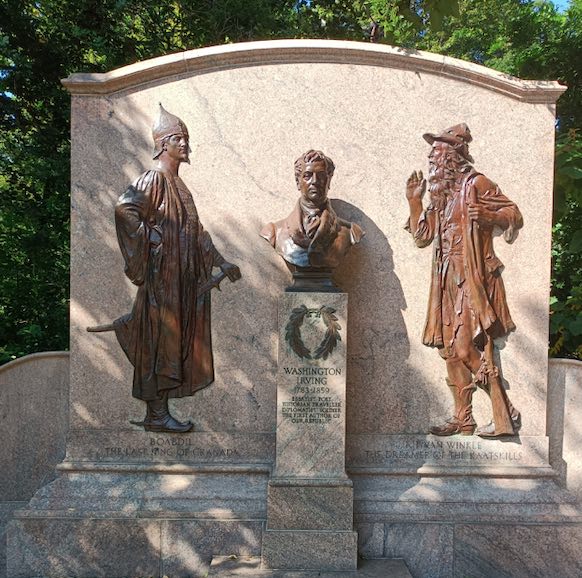
In 1809 A History of New York from the Beginning of the World to the End of the Dutch Dynasty was published by Washington Irving and purportedly penned by Diedrich Knickerbocker, a New Yorker of Dutch descent, to remind people of the state’s Dutch heritage. He related tales of idyllic villages and peaceful people and achieved his goal when the people embraced the character of Knickerbocker as a stereotypical NY personality. 


In 1820 Washington Irving took on the task of recounting a mystical tale based on local lore and Dutch society of the era. The story takes place in Sleepy Hollow, an incorporated village about 32-miles from Manhattan, adjacent to Tarrytown. It was published in Irving’s collection The Sketch Book of Geoffrey Crayon, Gent., and said to have been found among Knickerbocker’s papers.

This part of the Hudson Valley is documented as having been first inhabited by the Native American Weckquaesgeek and Sintsinct tribes. Legend has it that you may feel drowsy if you take a path along the river because a Native American shaman had placed a spell on the area to thwart enemy attacks. This may be the origin of the name. There are numerous supernatural sightings, the Flying Dutchman, Van Dam the lost partygoer, a maiden searching for her husband and baby and the Headless Horseman. New York’s Haunted History Trail includes many of these sites as well as haunted accommodations and restaurants. 


Hudson Valley inhabitants, from the native population on, felt there was something mystical about the land. Early Dutch settlers were superstitous and did not frequent places believed to be haunted. They also shared tales and it is the shiver-inducing tale of the decapitated horseman that was often recounted.


Irving’s story revolves around a Connecticut schoolteacher who attends a local landowner’s a party, courts his daughter and makes his way home on a lonely road. The story takes place circa 1790. Ichabod Crane’s trail is well marked, easy to follow and includes all the significant sites from the legend.


Crane’s one-room schoolhouse is an 1850 building in Kinderhook in use until the 1940s. It has been awarded a 'Legends & Lore' marker by the New York Folklore Society. Tours are seasonal.

Katrina Van Tassel’s home, scene of the party, was torn down in the 1800s and was replaced by the local high school.

The Headless Horseman was a Hessian mercenary hired by the British during the American Revolution. He was beheaded in a battle about 8-miles from Sleepy Hollow and rises each night to search for his head. Crane first encounters the headless spirit, while riding home in  what is now Patriot’s Park. The park was also the scene of the capture of revolutionary spy John André. He was hung and the event is remembered by the Captor’s Monument. The brook where Crane met the apparition still runs through the park. At this location Ichabod quickens his pace and misses the turn that will take him home.


The Old Dutch Church and 3-acre Burial Ground date from 1685. The Dutch Colonial Revival church was where Crane was choirmaster and the place where the horseman spends his days. Many famous individuals are buried here including Washington Irving, Elizabeth Arden and Andrew Carnegie. Maps of the burial plots are available on-site. 

The Headless Horseman sculpture is on Route 9 near the bridge where Ichabod sought safety. He disappeared and only his horse, Gunpowder, and his hat were recovered. hudsonrivervalley.com 


Washington Irving’s 1835 home, Sunnyside, is in Tarrytown. The house was designed in a mixture of architectural styles by the author and built around an existing 17th-century, 2-room, Dutch farmhouse. The house exhibits many original furnishings including his desk and books. The property has magnificent Hudson River views and is believed to be haunted by Irving himself.


Hudson Valley’s Great Jack O’Lantern Blaze sets fire to the night at the Van Cortland Manor. The event is internationally recognized for its more than 4,000 awe-inspiring hand-carved pumpkins, 7,000 illuminated jack o’ lanterns, synchronized music and lights and thematic displays. Fodor’s named it the best family attraction in the country and is presented on select dates September – November. hudsonvalley.org


In 1626 the Dutch West India Company brought 11 African male slaves, documented as “proud and treacherous,” into New Amsterdam. As the Dutch divided up the land into patents slaves were needed as workers and by 1664 their numbers had risen to 800. By 1710 New York was the site of the 2 largest slave sale sites in the nation. One of the patents, Philipsburg Mill mentioned by Irving in his book, was part of a farm with an enslaved staff of 23.

Frederick Philipse migrated to the Hudson Valley in 1653 and quickly became the owner of 50,000-acres. In the late 1600s Frederick built a lucrative grist mill on the Pocantico River. The Philipses became one of the largest slaveholding families in the north. They engaged in the slave trade and established a trading post on the coast of Africa. 


Philipsburg Manor is now a Tarrytown museum that features the daily life of the enslaved on a farm through the researched lives of the slaves who actually lived there and interprets a holistic history of the slaves and landowners during that era. Tours are immersive, interactive and led by knowledgeable docents in period attire. Visitors move to 4 different areas for presentations. The gift shop is filled with collectibles and souvenirs.


                  Tarrytown is believed to be so named because of the habit of local men to “tarry” in the tavern there. The tavern is gone but there are still many reasons to tarry there. Take advantage of the fall foliage and the menu of other options. This is the perfect time to spend time in Hudson Valley. #ILoveNY


Wednesday, September 13, 2023
Legendary Lalibela

“I sing to revive the memories, to dig up the knowledge that the spiral of time erases.”  Les Nubians

                  There are destinations so legendary that they defy imagination and description. They linger in your mind until you feel compelled to add it to your golden bucket list. Lalibela, in Ethiopia, is one such place. It is literally fabulous, “reminiscent of the fables”, and is a site of religious pilgrimage for all “the people of the book,” the Jews, Christians and Muslims. 

                  To better comprehend the Lalibala’s historic significance you can access the story of the Queen of Sheba’s visit to King Solomon as related in the Bible, the Koran and the Kebra Nagast, Ethiopia’s national epic. Each book’s account differs slightly but generally they agree that the Queen of Sheba, Makeda, visited King Solomon after hearing of his wisdom. As a learned woman she is captivated by Solomon and he with her. Her visit extends to six months before she departs, pregnant with the king’s child. 

Once home she bears a son and names him Menelik, “son of the wise.” When Menelik is twenty he makes a trip to Jerusalem where his father acknowledges him and makes him King of Ethiopia and upon the death of Makeda in 950 B.C. Menelik I becomes the first Solomonic Ethiopian Emperor. The empire lasted in an unbroken line until the rule of Haile Selassie ended in a military coup in 1974.

                  Currently there is no archeological proof that the Queen of Sheba ever existed. There is debate about where Sheba was located and some scholars now claim it was in Yemen not Africa. Because of Ethiopian documentary evidence we know that Christianity was practiced in Ethiopia by 300 A.D. and the country was the second in the world, after Armenia, to become a Christian country and the Coptic Church is still the country’s national church. The rock-hewn churches of Lalibela owe their existence to the country’s extensive Christian history. 

                  Ethiopian King Lalibela was born of a governor and a maid in the village of Roha where his mother was exiled. At his birth in 1162 he is swarmed with bees and this was taken as a sign by his mother. She named him Lalibela, “the bees recognize his sovereignty.” It is said that he was always a devout and religious young man. Because he was a perceived threat to the throne he went into a 1,600-mile exile in Jerusalem in the 1100s. Upon his return to his country he learned that Jerusalem had fallen to the Muslims, led by Saladin, in 1187 A.D.

                  Lalibela decided that he would build a new Jerusalem in Africa as a home for Christian veneration and pilgrimage. The center was to be created in north-central Ethiopia on an 8,000-ft. escarpment in the region of the Zagwe Dynasty. He deemed that each structure should be created from a single block of stone, with no mortar, and as a result the structures are carved out of a single piece of soft volcanic rock including doors, ritual passages, windows and pillars.

                  There are a total of eleven churches carved in the hypogean, rock-hewn, architectural style of the country. Workers began by drawing the contours of the church on the stone. They then proceeded to excavate the building using hand tools. Once the church was carved out they began to remove the stone from the interior. The construction took place from 1200-1224. Local lore tells us that the churches were constructed by angels. 


                  The eleven churches are situated in three zones and are connected by hand-carved passageways. Six churches are in the northern zone, four in the southeastern zone and one church, Beta Giyorgis, the Church of St. George, that stands alone. A 5-day ticket for the 11 churches costs approximately $50 (US). I suggest hiring a guide in order to learn as much as possible about the decorations, history and archeology.

Beta Giyorgis is situated on a 72-by-72-foot dais with a 36-ft. deep plaza. The church is in the shape of a cross and is adorned with rooftop Greek crosses. Other architectural highlights include three doors and twelve windows. Beta Maryam, the Church of Mary, is an absolute must see. In the interior of the church there is a pillar that is inscribed with information on the construction of the church and has a replica of Christ’s tomb. Only priests are allowed to touch and read the pillars. Biete Medhani Alem, Church of the Savior of the World, has five aisles and is considered the world’s largest monolithic church. Beta Golgotha, Church of Golgotha, has large paintings of saints on the walls and is believed to contain the tomb of Lalibela. Lalibela ended his life as a hermit after renouncing his title and is an Ethiopia saint. 

The remaining churches are Beta Masqal (Church of the Cross), Beta Danagel (Church of the Virgins), Beta Mika’el (Church of Michael), Beta Emmanuel (Church of Emmanuel), Beta Abba Libanos (Church of Father Libanos), Beta Merkurios (Church of Mercurius) and Beta Gabriel and Beta Rafa’el (the twin churches of Gabriel and Raphael). The various churches are decorated with symbols and paintings. 

The churches were inscribed on the list of UNESCO World Heritage Sites in 1978.

#unesco.org/en

Tourists need a visa to enter Ethiopia. Once in Addis Ababa Lalibela is approximately 475miles 

from Addis Ababa and airplanes fly to its regional airport. From there it is 17-miles from the town. Short haul buses are outside the airport to take you into Lalibela. Alternatively, you can take a bus from Addis but the ride is minimally 9 hours. Once in town you will have access to accommodations at all price levels and restaurants. Remember this is an international tourist destination. Highlights of a visit are attendance at a Sunday morning mass. Grab your golden bucket and go. #visitethiopia.