Tuesday, June 21, 2022

Richmond, VA: Convergence

                   In 1607, immediately after the founding of Jamestown, the English sailed as far as possible upriver to an area made impassable by the rapids at the fall line of the James River. The site was the location of a native village that was ruled by a  “werowance”, who was probably a relative of Powhatan. Thirty years later a trading post was established and in 1645 the colony’s militia erected Fort Charles.


                  Colonel William Byrd II inherited land at this place on the James River and in 1737 he founded Richmond. He named his settlement after a town in England where the Thames River bends and it strongly resembled his city. Richmond is an independent city because it is not part of any Virginia county and that independent spirit has been apparent since its earliest days. It has always been a place where new, forward thinking and alternative ideas and institutions take root. @visitrichmond

Early convergences of philosophies and ideals regarding the country’s direction occurred nationally throughout the 1800s with Richmond at its center. Richmond was chosen as the new capital of Virginia in 1780 because Williamsburg was considered too vulnerable to British attack. A colonial-style state capitol was erected 1785-88, designed by Thomas Jefferson and modeled after the 16 BC La Maison Carrée ancient Roman Temple in Nimes, France. Public tours grant access to the areas where Aaron Burr was tried for treason, Robert E. Lee accepted command of the VA forces and the Confederate Congress met. Created as the House of Burgesses in Jamestown in 1619, Virginia is considered to have the oldest continuous legislative body in this hemisphere. 

The nearby White House of the Confederacy was the home and headquarters of Confederate President Jefferson Davis from 1861-65. The mansion was built in 1818 and in 1861 the city purchased the furnished house as a gift to Davis. He refused and the confederacy then rented the home for his use. Here he met with his generals and cabinet until April 2, 1865 when fear of approaching Union forces caused him to abandon it. Lincoln visited the home on April 3rd.

Davis’ staff consisted of a minimum of 20 slaves, several of which fled servitude while working there. The servants were both rented and owned. Mary Bowser, educated in the North, returned to VA to serve in the Confederate White House as part of a Union spy ring, She played the role of an uneducated black domestic and conveyed crucial information to her contact. Virtual and in-person tours are offered. 


Museums have always been the keepers of our history and Richmond’s museums have always accomplished this skillfully. The American Civil War Museum is a complex of three museums, two located in Richmond, the American Civil War Museum at Historic Tredegar Iron Works and the White House of the Confederacy and the American Civil War Museum in Appomattox, VA. In 2013 the Museum of the Confederacy and the American Civil War Museum merged and in 2019 a new facility was opened to house both collections. This architecturally stunning structure was built within the existing walls of the iron works. The museum was the first to examine the Civil War across race, gender and nationality in a holistic way. Galleries are chronological and incorporate videos, photographs, memorabilia and greater than 500 artifacts. It was the country’s first major museum to acknowledge that slavery was the primary cause of he Civil War.  #ACWM


After an 18-month renovation the Virginia Museum of History and Culture reopened with 50% more exhibition space, 12 galleries, an outstanding 16-minute orientation film and exhibits that reflect the unique diversity that is Virginia. “Our Commonwealth”, the first exhibit, gives historical background and overview of the 5 major regions. “The Lost Cause” is a cutting-edge gallery that delves into the creation and endorsement of the ideology of the heroic and justified Confederate cause. Exhibits include artwork and artifacts that advanced this alternative history. The VMHC is phenomenal and not to be missed. #VMHC


                  America’s first state supported museum, as well as the country’s only museum open 365 days a year, is the Virginia Museum of Fine Art. The museum presents 6,000 years of world history through 50,000 works of art. It boasts one of the largest comprehensive collections and is one of top ten comprehensive art museums in the world.  You can easily spend the day here starting with the outdoor sculpture garden and Kehinde Wiley’s “Rumors of War”. One of the premier exhibits showcases the largest collection of Fabergé artworks outside of Russia. The “Beyond the Label” audio tour is available to enhance your visit. #VMFA


Wickham House was built in 1812 for attorney John Wickham. The Federal-style mansion became home to the family and at least 20 enslaved Africans. Mann Valentine II purchased the estate in 1882 and it became his home and a showcase for his private historic artifact and artwork collections. In 1898 a museum was established, now Richmond’s oldest private museum, with funds and art left by Mann in his will. The facility is inclusive of the Wickham House and galleries all dedicated to preserving and explaining the history of Richmond. House tours give us a glimpse of 19th-century life. The renowned textile collection, 30,000 pieces, contains items made in Virginia. 


A real gem here is the studio of Edward Valentine, a prominent sculptor most noted for his Recumbent Lee statue on Washington & Lee University campus. The studio is one of four extant 19th-century studios that offer tours.  The statue of Jefferson Davis is on temporary display at the Valentine Museum. The Davis statue was erected in 1907 on Monument Avenue and pulled down by protesters on June 10, 2020. It is now on display for at least 6 months while on loan from the Black History Museum & Cultural Center of Virginia (BHMVA).  www.thevalentine.org


                  The riches of Richmond and the convergence of old and new are found throughout the city and across venues. The Richmond Beer Trail was inaugurated in April 2016 and features nearly 40 breweries. A map notes those that are pet friendly. Make five stops on the trail and earn specialty gear. 

                  Hatch Local Food Hall showcases local restaurants. Tables inside and out and a play area make it family friendly. It is in the revitalized Manchester section of the city near the beginning of the Richmond Slave Trail. Ancarrow’s Landing was the slave ship docking port and from there the trail is 3-miles long.


ZZQ is a mandatory stop for a tasteful convergence of slow cooked barbeque and Texas food craftsmanship. Experience industrial chic décor and a casual atmosphere while enjoying barbeque and sides that will make lingering memories. It was named one of the 41 best BBQ restaurants in America. www.zzqrva.com


Dining and diversion meet in the unique and historic Hotel Greene. Guests dine in the restored lobby while waiting for their turn to play miniature golf throughout the rooms of the hotel. While golfing the team plays down corridors and in guestrooms encountering peepholes and other guests as they play through. 


Richmond is the ideal destination be your interest in history or more contemporary sites. Lose yourself in Richmond and find yourself delighted. #VisitRichmondVa


Monday, May 30, 2022

Pennsylvania’s Bear Creek Mountain Resort & Conference Center


            Let the travels begin! Many people are almost giddy with the thought of being able to travel again but even though circumstances are beginning to stabilize around a “new normal” those planning to travel continue to be mindful of safety protocols, mode of travel, affordability and accommodations.  Lehigh Valley’s Bear Creek Mountain Resort meets and exceeds all these requirements as well as adding a number of notable travel experiences.

            The resort is within driving distance of Washington, DC, Baltimore and New York. It is the nearest ski resort, 60-miles, to Philadelphia. The all-season resort, located in the Lehigh Valley between Blue and South Mountains, was populated pre-first contact, by the Lenni Lenape. They traveled the Great Minsi Trail, now Bethlehem Pike, as a trade route.  #discoverlehighvalley

Europeans arrived in the Lehigh Valley in the early 1700s, traveled the trail and forcibly removed the natives from the area and in 1737 the land was ceded to Pennsylvania in the Walking Purchase. German immigrants arrived around 1743 drawn by advertisements from land agents of William Penn. Census records from 1800 indicate that of the 21 African Americans residing in the valley only one was enslaved. She was a house servant in Macungie.


Bear Creek Mountain Resort is located in Macungie, founded in 1776 on what was formerly known by the natives as Maccongy, “feeding place of the bears”. In1857 the Rittenhouse Gap mine was established along with the 1850 Catasuaqua-Fogelsville Railroad. The railroad carried iron ore to valley furnaces for processing. Thomas Edison spent time visiting the mine to explore developing an economical method of iron ore extraction. The mine closed in 1944.  www.bcmountainresort.com 

A two-trail ski area opened in 1967 as Doe Mountain Ski Resort and after new ownership in 1999 it was reborn as the 52-room, year round, Bear Creek Mountain Resort & Conference Center. 


Specialty winter resort offers include 21 ski trails over 86-acres. The trails represent skill levels from beginner to the challenging Sasquatch Trail with a 50% slope. Tubing, ski rental, snowboarding, ski lessons and Mountain Trail Passes are also offered to both day and resort guests. Bear Mountain has been designated in the top ten Small Ski Area’s in both North America and the United States.


The menu of warm weather activities is even more creative and expansive. In the activity center you can sign up for archery shooting and ax throwing, Segway tours, pond fishing and guided mountain SXS tours. SXS tours take you on the ski trails to the mountain summit and along the tracks of the mining railroad. A unique Giant Swing helps you fly through the woods and over a pond in a 90-minute session that includes lessons and flight. Children can also experience Bear Creek Mountain Camp.


The resort’s Fitness Center is fully equipped with state-of-the-art apparatus available to registered guests. Paired with on-site, full-service, spa treatments and an outdoor heated pool, stays here are immersive wellness experiences. There are two dining facilities, the Grille at Bear Creek and the Trail’s End café that are available throughout all seasons. Designed for quick bites for outdoor enthusiasts the Mountain Eatery is open during winter months only. 


Hotel accommodations are spacious, have great views and provide

amenities including WIFI, deluxe bedding and safety protocols. 

            Bear Mountain Creek Resort and Conference Center is a perfect destination for these times. There are numerous on-site events and activities and guests can interact with others at a level at which they feel comfortable. The resort is close enough to other sites and attractions to make it an ideal hub from which to explore the surrounding area.

Lehigh Valley is filled with unique cultural sites including Pennsylvania Dutch Country and the Moravian settled cities. This year they are honoring the International Tricentennial Moravian Trail. The trail traces their route from Hernhut, Germany to colonies in the New World. The most notable colonies in Pennsylvania, Nazareth and Bethlehem, continue to have extant sites that date from the 1740s and are open to visitors.   


Bethlehem, a 30-minute drive from Bear Creek, is Bethlehem, PA, the official “Christmas City USA” since 1937 and is currently a tentative UNESCO site. The north side of the city contains the historic district and tours are offered year round. #VisitBethlehempa

            Allentown, 15-miles from Bear Creek, contains a significant American Revolutionary historic site. The colonies’ Chief Justice, William Allen, founded the city in 1762. The Allen family engaged in the slave trade but divested themselves of the business in the 1770s. The enslaved they held were freed upon the death of individual family members. It is believed the final three were freed in 1778 upon the death of William’s son.


            Allentown’s first church was constructed of logs in 1762. It was rebuilt of stone in 1773 and the Zion Reformed Church has stood on the original site ever since. The church, on the National Register of Historic Places, has functioned as safe haven during Indian raids, a Revolutionary War hospital and the Liberty Bell Shrine.


            In 1777 George Washington was routed at Brandywine Creek leaving Philadelphia vulnerable to occupation. It was decided that 11 bells, including the Liberty Bell, should be hidden to keep them out of British hands and being used to make weapons. The bells were secreted in hay wagons and relocated at night under heavy guard to Allentown. They were hidden beneath the floorboards until June 1778.


            The Liberty Bell Shrine is on the lower level of Zion Reformed Church. A replicated Liberty Bell and 46-ft. mural depicting the bell’s journey are showcased. www.Libertybellmuseum.org

            Begin and end your vacation at Bear Creek Mountain Resort with lots of adventure in between. There are outstanding opportunities to stay and play as well as connect with culture at your own pace and affordable rate.

#Visitlehighvalleypa   #BearCreekResortPA   #LibertyBellMuseum  #Moravians

#BethlehemPA


Saturday, May 28, 2022

One Hundred Years of Edgar Allan Poe in Richmond, Virginia


“From childhood's hour I have not been as others were, I have not seen as others saw. I could not awaken my heart to joy at the same tone, and all I loved I loved alone.” Poe


            Edgar Allan Poe was born in Boston in 1809 and died forty years later on Sunday, October 7th in Washington Medical College. The circumstances surrounding his death continue to be the object of numerous theories but his impact on the world of literature is set in stone. 


             Poe was born to actors Elizabeth and David Poe in Boston. David abandoned the family when he was one and Elizabeth died the following year in 1811. The orphan went to live with John Allan, a wealthy tobacco merchant and his wife Frances. Initially the family resided in a Richmond, VA house at Second and Franklin Streets, the first of several Richmond residences. 


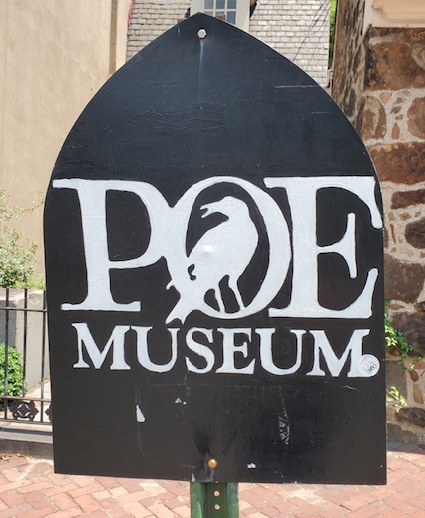
            Richmond has a strong claim to Poe’s legacy through exhibits at the Poe Museum complex that holds the world’s largest collection of Poe memorabilia and artifacts and is the sole museum dedicated to a literary figure in Virginia. The museum complex is showcased in the 1740 Old Stone House, the oldest extant residential structure in the city.


            He was stationed to guard the house as part of the Youth Honor Guard when the Marquis de Lafayette visited in October of 1824. Poe never lived in the house but it is only a few blocks from his first childhood home and near his first workplace. 


            The concept for the museum, originally conceived as a monument, was the brainchild of James Whitty, an avid collector of Poe memorabilia, and a group of other admirers. They founded the Poe Memorial Association, in 1906, around the theme of Poe’s poem “To One in Paradise”.  They did not garner enough support until 10-years later when they salvaged construction materials from the Southern Literary Messenger building.


            Preservationists allowed them to construct a shrine and memorial Enchanted Garden in the area behind the Old Stone House with the salvaged granite and bricks. The site opened to the public on April 26, 1922. The shrine at the rear of the garden showcases a bust of Poe. Visitors should take special note of the numerous details that relate to Poe’s life. The ivy lining the green was relocated from the grave of Poe’s mother and the garden benches were removed from the boarding house where Poe wed his 13-year-old first cousin Virginia Clemm. The Enchanted Garden is the site of numerous lectures, programs and events. “Unhappy Hour”, revelries with a Tell-Tale Heart trial, is held every third Thursday of the month. The museum is available for rentals and weddings.


            Poe was a cat lover and two black felines, Pluto and Edgar, live on the grounds. Pluto is the name of the cat in Poe’s short story “The Black Cat”.


            The collection is housed chronologically within three structures, the Old Stone House, the Memorial Building, and the North Building. The Old Stone House focuses on his personal life through exhibited portraits of significant people in his life, women he loved and his childhood bed.


             The Memorial Building contains his work desk and chair and career related artifacts. Items of his clothing are displayed along with his pocket watch. An empty coffin allows visitors to step inside and experience a buried alive photo op.


            Items exploring his mysterious demise and theories and research surrounding it are featured in the North Building. On display are his trunk, walking stick and a lock of his hair. “Poe’s Tell-Tale Hair” focuses on a 2002 analysis of a hair sample that did not add substantially to information on his cause of death. We still know only that he was found on Election Day, insensible and dressed in clothing that appeared not to be his.


            Purchases made in the gift shop support the museum. As well as the expected T-shirts, mugs and magnets there are many items that are unique and a bit quirky. The shop is well worth a visit.


            Poe stares dolefully out of a window in one of the buildings. Seek him out as you search for the real Edgar Allan Poe following in the footsteps of scores of international guests including H. P. Lovecraft and Salvador Dali.


“Those who dream by day are cognizant of many things which escape those who dream only by night" Poe (1841) 

#RichmondVa.  #PoeMuseum  #EdgarAllanPoe  #Theraven