Sunday, November 17, 2019

Central Virginia, Lynchburg


Contrary to what some might believe Lynchburg was named after John Lynch who took over the family’s James River  ferry service in 1757. In 1786 45-acres of John Lynch’s land was used to found the town that was chartered 29-years later. The location of the ferry service was memorialized in 2004 with Langley Fountain spouting a 190-ft. stream of water into the air. lynchburgvirginia.org

Lynchburg, situated in the Blue Ridge Mountain’s foothills, is referred to as the “City of Seven Hills” and because of its location and precolonial settlement, the city has been at the forefront of American history from its beginnings. The people and events involved are well documented, their paths are clearly indicated with markers and a series of unique museums and historic sites allow you to immerse yourself in Lynchburg’s legacy. Maps and guides are available at the Visitors Center.

Monument Terrace visually and physically connects the ferry landing and the Old Courthouse via Courthouse Hill. There are 132 steps and ten landings lined with eight markers and eleven sculptures. The views are noteworthy.

The Lynchburg Museum is located inside the 1855 Greek Revival Old Courthouse. During the final days of the Confederacy the Old Courthouse functioned as the capitol for six days. The museum provides an outstanding overview of area history from the pre-contact native presence until the present through photographs, artifacts and documents. Highlights of the collection include personal belongings of General Jubal Early and information on the Battle of Lynchburg. www.lynchburgmuseum.org

African Americans inhabited Lynchburg in the 1700s and in the 1800s their portion of the total population exceeded 40% and by the Civil War 20% of the black population was free. Slave auctions were held at 9th and Main Sts. on a large rock in front of Market House and their labor helped make the city the wealthiest of its size in the country. The backbone of the economy was tobacco, the first warehouse being built in 1797, and half of the blacks worked in that industry. The Legacy Museum of African American History interprets this history through artifacts, documents and artworks. On display is the Ann van de Graaf painting, “Lord Plant My Feet on Higher Ground”, memorializing the Civil Rights events and figures of the 60s and 70s. legacymuseum.org

Lynchburg did not fall into Union hands during the Civil War. Its major role was as a supply and hospital center, with the 2nd largest number of Confederate medical facilities.
Point of Honor Plantation is an 1815 Federal-style mansion. A tour begins on the exterior with a banister crafted by one of the 30 slaves on the 750-acre plantation. The house has its 1815-30 appearance with original woodwork, paint colors and era appropriate furnishings. The original owner, George Cabell, was Patrick Henry’s doctor and there is an outstanding medical exhibit on medicine of the times. pointofhonor.org

The Federal-style Sandusky mansion was built in 1808 on 1,200-acres and served as General David Hunter’s Union headquarters June 17-18, 1864. Two presidents, McKinley and Hayes, were on Hunter’s staff. A field hospital was set up in the barn and signal officers, after cutting a hole, accessed the roof. historicsandusky.com

Pierce Street Renaissance Historic District was originally established in the 1850s and become a Confederate military camp. At the end of the war a freedman’s school was established there. In the 1870s it became a 5-acre residential neighborhood for African Americans housing significant individuals. The two most notable sites are the Anne Spencer House and the Dr. Walter Johnson House and Tennis Court.


Anne Spencer was a Harlem Renaissance poet who lived in the 1914 Queen Anne home for over 60 years and her home is furnished exactly as she left it. Here she entertained the great minds of her day including King, Cullen, Robeson, Carver and Booker T. Washington. In her exquisite garden sits a one-room cottage, Edankraal, a combination of her name, her husband’s name and the African word for enclosure. The “Prince Ebo” fountain in her garden has a sculpted iron head that was a gift from DuBois. annespencermuseum.com

Dr. Walter Johnson’s home and restored tennis court is on the same block. He was a physician, tennis player and coach. He trained Arthur Ashe and Althea Gibson among others on the court adjacent to his home.

The incredibly unique Old City Cemetery Museums & Arboretum was established by John Lynch in 1806. Today this 27-acre public history park consists of five museums, 20,000 burials, heirloom plants and the largest public display of antique roses with the oldest dating from 1581. Nearly 2/3 of the burials are African American and an interpretive sign details burial customs of West African origin. The Cemetery Center houses the Mourning Museum exhibiting items of mourning attire and customs. A highlight of the gallery is a portable embalming kit.

In the 1840s and 50s those with infectious diseases were quarantined in the Pest House were most patients died. The 2-room, Pest House Medical Museum was the office of Dr. John Terrell who was appalled at the conditions during the Civil War and instituted standards of cleanliness and lowered the death rate from 50% to 5%. Audio stations relate historic information about Terrell’s office and the quarantine room. Displays include a surgical amputation kit and operating table. The cemetery offers a complete schedule of programs. October Candlelight Tours are particularly popular. www.gravegarden.org


The boutique Craddock Terry Hotel at Bluffwalk Center is an award-winning, 44 room, Historic Hotel of America inside the 1888 Craddock-Terry Shoe Corporation’s original brick warehouse. Unique architectural features, granite walls, arched casement windows and handmade bricks, enhance the public and private spaces. Penny Loafer, a wire fox terrier, serves as the official greeter and concierge. The 1896 William King Jr Tobacco Warehouse hosts events and is an ideal location for weddings and receptions.

Accommodations have views of the Blue Ridge Mountains, offer designer linens, upscale amenities and continental breakfast is served in a shoe shine box. There are two restaurants on the premises, Waterstone Pizza and Shoemaker’s American Grille, both serving culinary masterpieces.

Friday, November 8, 2019

Cleveland, Living with Legends


In 1669 the French explorer de La Salle, the first European in the Ohio was met by the Iroquois Indians who migrated there in the early 1600s. The river and the state would be named the Iroquois word for “beautiful river”. The land was a bountiful native beaver hunting ground and although the Iroquois were quickly decimated and supplanted by the tribes including the Delaware and Shawnee, the French established posts to trade with the natives. After the Revolutionary War, in 1800, as part of the Northwest Territory, Ohio became part of the American frontier. www.thisiscleveland

Former Revolutionary soldier, General Moses Cleaveland, was hired in 1796 to survey the area and one of the first new towns on the shore of the Cuyahoga River was founded by him and named in his honor. The “a” was dropped in the 1831. Cleveland, from the outset, was a beacon for events and legendary individuals and early on noteworthy Native Americans made their mark on the region.
Stigwandish, “Standing Stone”, was a Seneca chief who assisted Cleaveland’s survey party and during the War of 1812 he alerted the settlers to an impending British attack. Tecumseh, "Shooting Star", was one of the country’s most historic leaders. He vowed to resist white incursion onto tribal land by uniting all the tribes, creating their own country and using armed resistance.

Cleveland History Center of the Western Reserve Historical Society provides an excellent introduction to Northeast Ohio’s legendary figures from 1790 to the present. The center’s Cleveland Starts Here® includes a pictorial timeline and a video kiosk with pictures and biographical information, the first map of the city and artifacts. The complex also features the Crawford Auto-Aviation Museum, Carl & Louis Stokes Making History, Kidzibits Hands-on Gallery, Chisholme Halle Costume Wing and the restored Euclid Beach Park Grand Carousel. Chisholm Halle Costume Wing. www.wrhs.org

Garrett Morgan’s parents were slaves and in 1895 he moved to Cleveland and, after starting as a sewing machine repairman, he was wealthy by the 1920s and an inventor of some note. He patented the first traffic light and in 1916 a gas mask that saved the lives of miners trapped beneath Lake Erie and was ultimately used by fire departments and in WWI. A plaque honoring his achievements is at the Garrett A. Morgan Water Works.


League Park originally opened in 1891 and was listed on the National Register of Historic Places in 1979. The Negro Leagues, Womens League, Babe Ruth and Satchell Paige are among the people whoplayed there. The 2-story ticket booth houses the Baseball Heritage Museum with its displays dedicated to the diverse history of the game. Memorabilia, photographs, uniforms and other artifacts contribute to the interpretations. www.baseballheritagemuseum.org


Branch Manager William Bradford brings the legendary Langston Hughes to life in the 1998 Langston Hughes  Library Branch. Hughes attended Cleveland’s Central High School, the first to enroll blacks before the Civil War, and attributed his years there as a stimulus to his imagination and desire to write. He was the class poet and editor of the school annual and would go on to become the “Poet Laureate of the Negro People”. The library’s special collection showcases photographs, books and documents. Highlights of the collection are his 1920 yearbook and his poem, “A Negro Speaks of Rivers” written across the ceiling. Large sculptures on the library exterior depict different forms of protest. https://cpl.org/locations/langstonhughes
Hughes boarded in the attic of the home at 2266 86th St. from 1916-20.


The Buckland Museum of Witchcraft & Magick opened in 1966 and relocated to Cleveland in 2015 to interpret legendary stories in an unbiased manner. The museum chronologically and anthropologically explores folklore and the paranormal through a collection of artifacts, photographs and historic objects. Highlights of the tour are the first Wiccan headdress, Raymond Buckland’s purple ceremonial robe, a centuries old mandrake root and a tarot card display. A personal card reading can be arranged on the premises.
www.bucklandmuseum.org


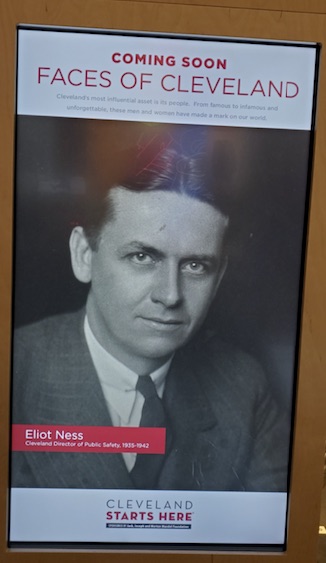
Cleveland Police Museum relates the history of crime and punishment in the city. On view are photos, documents, firearms and a jail cell but the big draw here is the Eliot Ness display that focuses on the 1935-38 Torso Murders. This series of 13 murders was never solved by Safety Director Eliot Ness and even after the murders ceased the killer continued to taunt Ness. The case remains open. www.clevelandpolicemuseum.org


Next stop, the birthplace of the legendary Superman. In 1932 18-year old Jerry Siegel created Superman at 10622 Kimberly Ave. The home is privately owned but fans can take a picture with the signature “S” on the exterior. A plaque marks the spot.


The legendary holiday movie, “A Christmas Story”, Ralphie Parker residence has been restored and is now part of a complex that includes the house, garage, museum and visitor center. Tours of the house are unique because visitors can touch and sit and examine items in the house. The museum showcases props and costumes from the movie and visitors can purchase their own Official Red Ryder Carbine-Action Model Air Rifle or lady leg lamp. The guided tour led by Ernie Scales is excellent and filled with movie information, photo ops and merriment. www.achristmasstoryhouse.com


The 7-floor Rock & Roll Hall of Fame was established in 1983 and is a glass incarnation of an ancient pyramid built to preserve the people’s legacy and legends. The Rock Hall shares the history and power of music through extensive use of audio, video and an incomparable collection of artifacts, stage outfits and memorabilia. Highlights of a tour are the Early Influences, Rock Legends, culturally thematic galleries and The Garage where you get to channel your inner rock star. After visiting the Hall of Fame end your tour with the Connor Theater presentation of “The Power of Rock Experience”. Before you depart stop in the gift shop and, just outside, Johnny Cash’s tour bus. rockhall.com

Westin Cleveland Hotel recently underwent a $64-million renovation. The 484-room hotel is centrally located and is walking distance to many attractions. The hotel offers great views, exceptional service and a WestinWORKOUT® Fitness Studio. There are an on-site Starbucks and Urban Farmer, farm-to-table restaurant. The food is locally sourced and cooked to perfection.
Mingle with the legends. @TheCle