Sunday, October 20, 2019

Experience Saint Lucia


Saint Lucia was possibly inhabited 3,000 years ago by the Ciboney and based on  archaeological research and artifacts it has been proven that “Iouanalao” island, “land of the iguanas”, was settled by the Arawaks around 2,000 years ago. They were invaded around 1,000 AD by the South American Carib Indians whose hostility extended to the first Europeans making colonization difficult. Columbus may have passed the island but in 1499 it was Columbus’ former navigator Juan de Cosa who placed it on his maps as El Falcon and 3-years later it was depicted on a papal globe as Santa Lucia. #travelsaintlucia

François Le Clerc, the notorious pirate ‘wooden leg’, and his band were the first Europeans to reside on the island. In the mid-1550s he attacked Spanish vessels from his base on Pigeon Island, now a 44-acre National Landmark connected to the mainland by a causeway. The park is actually a microcosm of the larger island with a menu of water-based activities, the ruins of an 18th-century fort, 2 beaches, nature trails, a history interpretation center and the option to climb the 330-ft. Signal Peak for stunning views of the NW coastline.

Pigeon Island is also the site of Saint Lucia’s most renowned annual events. International performers entertain crowds during the Saint Lucia Jazz Festival, the Roots & Soul Festival and the Saint Lucia Carnival. Saint Lucia’s lavish fêtes spill over from Pigeon Island and are staged throughout the island throughout the year. There is always a party and they include Creole Heritage Month, Food and Rum Festival and Dive Fest. Information is available online. stlucia.org/en/experiences/festivals-events


Sandals Grande St. Lucian provides accommodations and 5-star dining, activities and 2 courses offering challenging golfing opportunities near Pigeon Island. The multi-award winning resort is perfect for that special vacation. Guests can be wed in a chapel suspended over-the-water and spend their honeymoon in a private glass-floored suite also over-water. sandals.com/grande-st-lucian


The history of the 27-mile by 14-mile island is one of competing claims between Britain and France and it changed hands more than twelve times before Britain took ownership from France in 1814. Early on France was a dominant force and it was they who named the island after St. Lucy of Syracuse. In 1765 two Frenchmen started the first plantation and by 1780 more than fifty dotted the island. The French governor emancipated the slaves in 1794 but they were quickly returned to their former condition after the British invaded. When the British ended slavery in 1834 there were 13,000 slaves, 2,600 free blacks and 2,300 whites. Former enslaved individuals had to serve a 4-year apprenticeship, working for free ¾ of the week for their former master thereby adding years to enslavement. One of the last tangible vestiges of slavery is a slave jail In the Roseau Valley and a number of buildings used to house slaves. The site is preserved near the St Lucia Distillery.


Castries, the capitol and largest city on the island, was founded in 1650 as a fort and village of Carénage meaning “safe anchorage”. In the 1700s it was renamed Castries. It continues to serve as a safe port for cruise ships and sea transport to other islands. The Castries Market opened in 1894 and remains an important shopping venue for locals and visitors. Directly across the street is a craft market that is ideal for purchasing affordable handcrafts and souvenirs.


On May 11, 1999 the Cathedral of the Immaculate Conception was designated a Minor Basilica. It is the largest church, 200-ft. by 100-ft., in the Caribbean and has a stunning interior. The church began construction in !891 replacing earlier structures. Of special note are murals by Sir Dunstan St. Omer and stunning Afro-centric stained glass windows. @Travel_StLucia

Derek Walcott Square memorializes the 1992 Nobel Laureate winner in literature. The 2-acre square dates from the 1760s and features a bust of Walcott and ample seating for contemplation.

With all the things Saint Lucia has to offer visitors are still awed by the islands’ stunning landscapes crowned by the 2004 UNESCO World Heritage Site, the 7188-acre Pitons Management Area. The 2,526-ft. Gros Piton and the 2,437-ft. Petit Piton are joined by the Petit Mitan ridge and are a portion of a collapsed stratovolcano area that spans 434-miles. There are numerous activities in the region but the international bucket list adventure is the challenging Gros Piton Nature Trail Hike. @TravelSaintLucia


Windjammer Landing Villa Beach Resort is an all-inclusive property situated on Labrelotte Bay. Accommodations all offer panoramic views from hillside villas. A plethora of activities are offered daily and off-site activities can be scheduled. Shopping venues, a world class spa and five restaurants are located on-site so that guests and their families need never leave to have the time of their lives. windjammer-landing.com

Saint Lucia is the destination of choice for experiential travel because of the beauty, number and variety of activities and serenity it offers. Why not experience Saint Lucia? www.stlucia.org/en


TRAVEL TIPS:
The National Harbor celebrates the December holiday in a huge way. Gaylord Resort will be celebrating a Dr. Seuss’ How The Grinch Stole Christmas! themed Christmas on the Potomac from November 15 – January 5. Resort highlights include Reindeer Rush Ice Tubing, Christmas Village, Winter Square ice skating, laser atrium show and ICE!, 2-million pounds of ice carved into intricate sculptures.
MGM National Harbor will commemorate the 25th anniversary of the song, “All I Want for Christmas”, in the best way possible. Mariah Carey will be performing there on December 9th. Details are available at www.ChristmasOnThePotomac.com.

Sunday, October 6, 2019

DeKalb County, Georgia: The Presence of the Past


The history of DeKalb County has been archeologically traced back as far as the late Ice Age and Indian mounds from the Late Archaic Period have been found that predate the 1567 Spanish claim to the land by thousands of years. When Juan Pardo surveyed the region two significant Indian trade trails already existed and members of the Creek Confederacy the, “People of One Fire”, lived there. Europeans encroached on native land illegally until the 1821 Indian Springs Treaty forced natives to move and more Europeans quickly settled in large numbers. discoverdekalb.com

DeKalb was carved from three other counties and named to honor Johann de Kalb, a Bavarian who changed his name and served in the American Revolutionary War, in 1822. Approximately 10% of Atlanta is located In the county, the most diverse in the South and more than 64 languages are spoken. Just as the population is diverse so too are the shopping, dining, accommodation and activity options. One of the most interesting aspects of discovering DeKalb is uncovering singular cultural and historic connections that resonate in our time.

The 1992, 160,000-sq. ft., Fernbank Museum of Natural History is the natural place to begin your explorations in the exterior Dinosaur Plaza where a family of bronze prehistoric Georgian Hadrosaurs greet you. The museum interprets the development of the earth, prehistoric world, international cultures and state specific displays. Visitors are greeted in the atrium with Giants of the Mesozoic, reproductions of the 47-ft. long Giganotosaurus, the world’s largest carnivorous dinosaur and the 123-ft long plant eating Argentinosaurus accompanied by two flying reptiles. Highlights of the museum include A Walk through Time in Georgia, the fiber-optic ceiling Star Gallery and a 4-story 3D theater.

The adjacent 16-acre WildWoods offers elevated boardwalks with treetop views and leads to Fernbank Forest, the oldest old-growth Piedmont forest in a major US city. Six trails are available to access the 65-acre area and view trees up to 16-stories tall. fernbankmuseum.org
Emory University’s Michael C. Carlos Museum’s roots date back to 1876. The museum’s current collection is one of the most wide-ranging in the nation and thematic galleries are dedicated to major works from Africa, the Americas, Asia, Near East, ancient Egypt, Greece and Rome. Highlights include mummified animal remains and Late Egyptian Period mummies with coffins and Nubian artifacts. Emory focuses on education and research and their outstanding schedule of programs reflects this fact. carlos.emory.edu
Stone Mountain State Park, Georgia’s most visited attraction, is easily one of the most controversial in the country. Geologically the mountain is part of the granite core of a volcano. DeKalb’s first European colonists were met by regional natives who had inhabited the top of the mountain for ceremonial and meeting purposes for 8,000-years. In the 1830s the granite was quarried and in 1847 it was named Stone Mountain. During the Civil War Union General Sherman’s troops bivouacked there and postwar Shermantown a part of Stone Mountain Village, was established at the mountain’s base by emancipated African-Americans.

Carved on the north face of the mountain is the largest bas-relief  sculpture in the world depicting the Confederate generals Jefferson Davis, Robert E. Lee and Stonewall Jackson. In 1914 the United Daughters of the Confederacy moved to create a Confederate memorial on the face of the mountain and in 1915 William Simmons reignited the KKK in a ceremony atop Stone Mountain. The carving remained incomplete and was purchased by the state in 1958 for $2-million as a “memorial to the Confederacy” but would receive no tax dollars. It was dedicated in 1970 and completed in 1972.
Activities in the 3,200-acre park include hiking, biking, fishing, golfing, Summit Skyride and Historic Square, reconstructed original GA plantation and farm  homes from 1792-1875 including  slave cabins. A seasonal laser light show of the carvings now contains Dr. King, imposed at one point, over the generals, and a portion of the “I Have a Dream Speech”. stonemountainpark.com
Many people became familiar with Atlanta’s Center for Disease Control (CDC) in the Walking Dead. No scenes were actually filmed there but you will be happy to know that you can visit the facility with a little planning and ID. European maladies began to wipe out Native Americans on contact in the 1500s and de Soto’s 1540 expedition heralded massive outbreaks of disease. The death rate has been estimated as high as 95%. This, the US’s first public health crisis went uncontrolled but it would not be the last. In 1798 the Marine Hospital Service (MHS) was founded to monitor healthcare for merchant seamen and in the 1800s services were expanded to include medical inspections of immigrants, national quarantines and interstate disease prevention and control. Malaria was a huge health issue in the 40s facilitating the creation of the office of Malaria Control in War Areas. Agency efforts were centered in the southeast because many of the WWII bases were located there and it was the region with the largest number of disease transmissions. Atlanta was selected on July 1, 1946 as the headquarters of the Communicable Disease Center.

The David Sencer Center for Disease Control Museum at the 45-acre CDC Headquarters. offers self-guided and guided tours of the three main areas over 2-levels, temporary exhibits, “The Story of the CDC” and “The Global Symphony”. Five short videos orient you to the exhibits that include galleries on specific diseases, service history and procedures combining artifacts, dioramas, videos and interactives. The tour ends with an opportunity for a photo op in a full safety suit regalia. cdc.gov/museum

DeKalb County provides a wonderful way to connect history with modern culture through visits to unique sites and attractions. Enhance your vacation, learn something!


Friday, September 20, 2019

Wilmington, Delaware’s “Chateau Country”


“…my most sincere respects, and accept yourself assurances of my constant affection, and my prayers that a genial sky and propitious gales may place you after a pleasant voyage in the midst of your friends.”    Thomas Jefferson to Pierre du Pont 1802

In 1799 Pierre-Samuel du Pont de Nemours and two sons left France to settle in the United States. This voyage would alter the course of American history. Pierre had been elevated to nobility because of his position with Louis XVI as an economist, secretary to the Assembly of Notables and his assistance in crafting the 1783 Treaty of Versailles that ended the American Revolution. The journey was motivated by the fact that he had been imprisoned during the French Revolution in 1792 and only escaped the guillotine because of the death of Robespierre. After reimprisonment along with his son Eleuthere, in 1797 he made plans to leave the country.

Family legend has it that Eleuthere Irenée du Pont, while hunting in 1800, noted the poor quality of American gunpowder. In France he had trained under Antoine Lavoisier at the Royal Powder Works and he selected a location on the Brandywine River, accessible to transportation and sufficient water power, to establish a gunpowder operation. He purchased the land in 1801 for $6,700. The company prospered and in the 1860s supplied 50% of the gunpowder used in the Civil War.

The American ancestral home of the du Ponts has come to be known as Chateau Country because of its general landscape with rolling hills and streams and its elegant estate museums. Nestled in the Brandywine Valley of Northern Delaware, mere miles from Philadelphia, Pierre hoped to create a community for French exiles and Eleuthere hoped to found a viable company. Today visitors can trace the family trail and have a unique vacation filled with fine dining, magnificent views and historic house and garden tours all with an international flair.

Chronologically Hagley Museum and Library should be your starting point. Situated on the Brandywine’s shores, the restored gunpowder mill complex consists of the first du Pont family home, built on 65-acres in 1802. The museum interprets the history of du Pont’s Eleutherian Mills, the family and early industrial technology.  A narrated bus tour, a must, guides you along the Powder Yard Trail with stops at the worker’s quarters and several demonstration sites. Highlights of a visit to the current 235-acre site include the first office, the largest Osage Orange tree in America, an orientation video, “Industry on the Brandywine” and a number of interactive exhibits. hagley.org


Winterthur Museum, Garden & Library, the estate of Henry Francis du Pont, is situated amidst 60-acres of gardens and features a superior display of American decorative arts from 1640-1860 showcased within a 175 room mansion. Complete room settings from each of the 13 colonies make up the 150 colonial rooms he relocated to Winterthur and the more than 90,000 furnishings include Martha Washington’s mirror, 22 panels of 1700s Chinese wallpaper and a selection of the Washington’s porcelain china. The home had the first heated pool in the country. Grounds’ tours are via open trams and provide views of seasonal plantings, 8-acres of azaleas, the Enchanted Woods, a Forbidden Fairy Ring with misting mushrooms and a temporary exhibit of follies placed throughout the grounds. Take the Introductory Tour and be prepared to be awed.


Until January 5, 2020 “Costuming the Crown” will be on view. A series of galleries thematically display costumes from the Netflix series, “The Crown”, as well as extensive production information, videos and memorabilia. www.winterthur.org


Alfred du Pont built the Neoclassical, 102-room, Nemours for his wife in 1909-10. The 47,000-sq. ft. chateau is reminiscent of Versailles’ Petit Trianon complete with sunken gardens and magnificent views. The mansion is flanked by the Catherine Gates. The Russian Gates, were once owned by Catherine the Great and the English Gates are from a castle belonging to Henry VIII’s wife Catherine Parr. Highlights of the interior are the notable pieces, Lafayette’s chandelier and Marie Antoinette’s clock. Self-guided and tram tours of the grounds and gardens are offered. nemoursmansion.org


The 1,077-acre Longwood Gardens is one of the most renowned botanical gardens in the country. The complex features 11,000 plants and trees, a 4-acre conservatory with 20 interior gardens and a half-mile greenhouse. An exterior waterfall and fountains can be enjoyed from benches that line the paths. A schedule of events is available online. Note: Longwood is in Kennett Square, PA. www.longwoodgardens.org


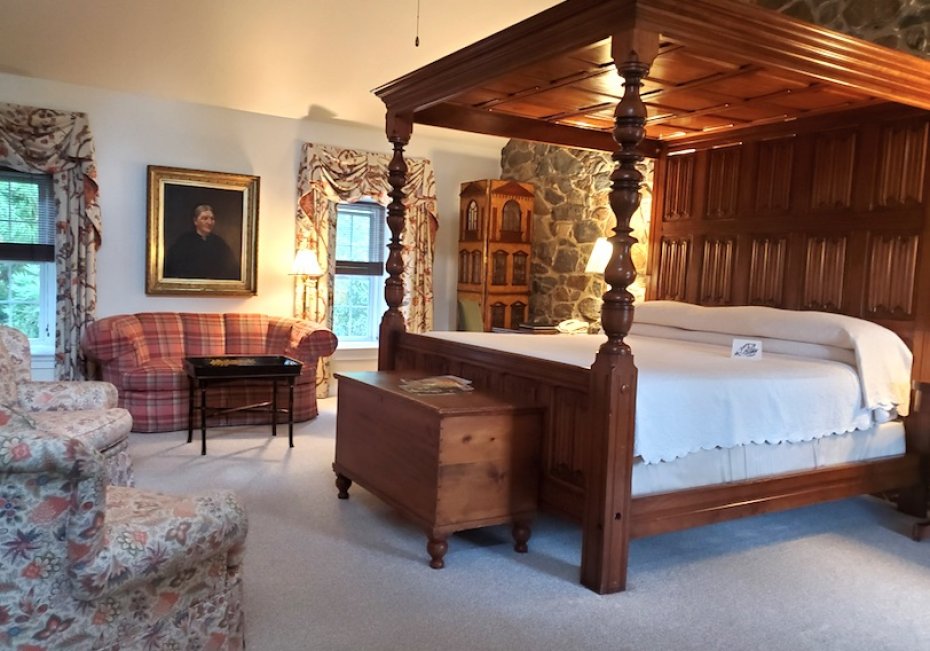
There are no more perfect accommodations for visiting the area or a romantic getaway than The Inn at Montchanin Village. The inn, the entire village of Montchanin, is made up of eleven meticulously restored historic homes with 28 rooms and suites dating from 1799 to 1910. The village was once part of a du Pont estate situated on a former Indian trail at the juncture of three roads. Amenities include designer linens, canopy beds and upscale bath products. Defining architectural elements, interior stone walls, fireplaces, front porches and private gardens add to the luxury experience. The Inn is a designated Historic Hotel of America.


Krazy Kat’s, an on-site French restaurant, is located inside a former blacksmith shop and is open to guests and visitors alike. The menu is a creative seasonal blend of American, French and Asian cuisine served for breakfast, lunch and dinner. The imaginative décor, the service and the meals are outstanding. www.montchanin.com

Wilmington is particularly ideal for a Philadelphia getaway. It is 30-minutes and a world and lifestyle away. www.visitwilmingtonde.com