Wednesday, May 29, 2024

AMAZING ARLINGTON, VIRGINIA

“For our elders and ancestors, whose voices were silenced but whose courage created us.”

The earliest recorded documentation on the area that is now Arlington, Virginia was recorded by Captain John Smith in June 1608. Smith painstakingly described the geography and indigenous villages, approximately 200, he encountered while in command of a 30-foot-long shallop manned by 14 men. The land was traditionally the ancestral home and hunting ground of the Doeg, Pamunkey, Piscataway and Tauxenent tribes. To date, greater than twelve prehistoric Native American sites have been located within the county. #allinarlington

Gulf Branch Nature Center, located in the Gulf Branch Stream Valley, was a Native American fish camp. The 19th-century log cabin’s main exhibit showcases park artifacts, Woodland Indian information, pottery and a replicated version of Smith’s 1608 map. 

By the end of the 17th-century there were a few colonists and remaining natives in Arlington. In 1841 it was ceded to the government to become part of the Federal District of Columbia, the nation’s new capital. In 1847 it was retroceded to Virginia and became Arlington County. At 26-square-miles It is the smallest self-governing county in the US. Petite though it may be, Arlington County has so much to offer that it is a destination in itself as well as a convenient hub for daytrips to the surrounding area. 

Washington Metropolitan Area Transit Authority (WMATA) has 11 stations in Arlington, one of which, Rosslyn Metro Station, houses one of the world’s longest continuous escalators. The ride is 194-feet, 8-inches and takes more than 2-minutes. For those preferring to see Arlington in several different ways there are 10 walkable, eclectic neighborhoods to investigate, 1,100-acres of parks to explore and 75-miles of multi-use trails. Arlington earned the title of Fittest City in America 2018 to 2023 from The American College of Sports Medicine. No matter what your transportation options the menu of sites and attractions will leave you in awe. 

Arlington, because of its location, has always played a significant role in US history. There are 34 sites on the Black Heritage Trail, showcasing their history from the colonial to the modern era. 

Benjamin Banneker was a free man who surveyed Washington, DC. He was an astronomer, mathematician, clockmaker, writer of his own almanac and abolitionist. An original 1-foot-square Benjamin Banneker Boundary Stone marked on the north side with 1791 is situated in a fenced in area in Benjamin Banneker Park. 

Dr. Charles Drew ‘s childhood home is a National Historic Site viewable from outside only. His research in blood transfusions led to the ability to develop blood banks, saving thousands of lives, in WWII. In 1941 he was named Director of the first American Red Cross Blood Bank.

The Ball-Sellers House is the oldest extant house in Arlington. John Ball, the original owner, built the house on 166-acres in 1742. The Carlin family moved into the house after Ball’s death and owned at least 3 slaves, who worked inside the home, Nancy and two unnamed men. Bronze markers, inscribed in remembrance, have been placed on the lawn. These “stumbling stones” are the first dedicated in the state.

The most visited sites in the 640-acre Arlington National Cemetery, the second largest in the country, are those of the heroes who are interred there, the Tomb of the Unknown Soldier, John and Robert Kennedy, Joe Louis, Medgar Evers, Thurgood Marshall, Ruth Bader Ginsburg and the Changing of the Guard. The best way to tour the cemetery is by tram with narration and 6 tour stops. 


Arlington Cemetery sits on land that was once the plantation of Robert E. Lee. The estate was confiscated by the Union in May 1861 to build forts and establish headquarters because of its proximity to southern lines. Fleeing African Americans settled there to be safe and eventually Freedman’s Village, more a campsite, was established there in 1863. In 1865 the Freedman’s Bureau took over and founded a real village with homes, shops and schools.


On May 13, 1864 Brig, Gen Montgomery C. Meigs began burials on the grounds to ensure that the Lee’s never lived there again. Mrs. Lee left the grounds in 1861, leaving the house and Washington relics in the care of her enslaved housekeeper, Selena Gray. Selena protected the property to such an extent that the George Washington items were cataloged and taken to the Smithsonian and 33% of the furniture on the


tour is original to the mansion, saved by Selena.


James Parks was born on Arlington Plantation in 1843. When they took control he joined the Union and became the first gravedigger. Prior to his death in 1929 he requested to be buried there. According to the law he was not military and could not be interred there. The government passed a special act to permit his burial with full military honors and he rests in Sec. 15, Grave 2. President Truman desegregated Arlington in 1948.


The 1802 Greek Revival mansion sat on 1,100-acres overlooking DC. The Lees wed in the parlor. Tours are available. The plantation had as many as 200 enslaved and 2 restored slave quarters are on view in the rear of the house. The quarters were those of the house workers and are original.

The free Drug Enforcement Administration (DEA) Museum ‘s mission is to relate the history of drug use, explore the i


mpact of drugs on the individual and society and interpret the role of DEA agents. Featured exhibits are a Pablo Escobar death mask and a prison suit and two gold and diamond-encrusted guns owned by El Chapo. @stayarlington

Residence Inn Arlington Rosslyn is perfectly located to access all the activities in Arlington and Washington. It offers all of the bedroom amenities and a full kitchen, fitness center and full breakfast. 

Be amazed in Arlington!


Experience Flyover Chicago

“Now I’m flying through the stars, hope this ride will last forever!” Chaka Khan


                  Visitors can opt to view the “real” Chicago through a series of walking tours, by water aboard a boat cruising the Chicago River, the world’s sole backwards streaming river, created by a public project in 1900 to protect the freshwater supply into Lake Michigan, or by flying over it using state-of-the-art technology created just for the Flyover Experience. Chicago’s newest attraction is an exhilarating aerial-type experience that soars across the city at an adrenaline pulsing pace. Chicago’s nearly 3-million residents occupy 77 unique communities on 234-square-miles of land, all best introduced by Flyover Chicago. #Choosechicago

                  Prior to first European contact Shikaakwa, as it was known by Native Americans, was a trading site and migratory hunting ground at the juncture of the Chicago River and Lake Michigan. Robert de LaSalle produced the first written mention of an area he pronounced as Checagou in his 1679 memoir. Father Jacques Marquette, a French missionary, and Louis Jolliet, a French-Canadian trader are recognized as “discoverers” of the region in 1673. Regional tribes then established a transitory trade system with the French for the next hundred years.


                  A French trader of African descent burst onto the scene in 1779. Jean Baptiste Point du Sable established the first permanent trading post where the river met the lake. He was born in Haiti of an enslaved mother and French sea captain father. His mother died when he was ten and his father had him educated abroad. He spoke several languages, collected fine art and had highly developed business acumen. He was the first nonindigenous settler in Chicago where he owned 800-acres, a 5-room home, a trading post, and a complex of buildings including housing for his workers. His life embodies the qualities of the city itself, resilience, strength, creativity and the ability to embrace different cultures. On October 25, 1968 he was officially recognized as the Founder of Chicago. A bust of du Sable is at 401 N. Michigan Avenue. themagnificentmile.com

                  Chicago is considered the Birthplace of Modern Architecture largely due to The Great Fire of 1871 that resulted in the loss of 18,000 buildings and a building boom that drew the country’s best architects. In 1885 the first skyscraper, a 10-floor, Home Insurance Building, was completed. Frank Lloyd Wright also came and designed structures. Two, the Robie House and Unity Temple, are now UNESCO World Heritage sites. 

Chicago was a hub for newcomers from 1850 through 1910, some from other cities and many European immigrants. From 1916-70 much of the movement was Black Migration from the South for economic opportunity and more than 500,000 African Americans moved to the city. WWII increased European migration because of wartime conditions. The influence of new cultures and Chicago’s unique ability to absorb new cultures and be enhanced by the inclusion is woven into the fabric of the city.


 “The Bean” is an iconic artwork designed to capture the skyline and reflect it to onlookers in Millennium Park. “Cloud Gate,” its formal name, was designed of 168 reflective stainless-steel panels to be 33-feet tall, 42-feet wide and 66-feet long for a total weight of 110-tons. It is one of the largest permanent public outdoor artworks in the world and the first of its type in the US. 

The Chicago Board of Trade Building was constructed in 1930. The 45-story, Art Deco, building was the tallest in the city until 1965. Atop the building’s tower stands a 31-foot, aluminum, 6-ton sculpture of Ceres, Roman goddess of agriculture, holding a sheaf of wheat and a pouch of grain. She wears a crown of wheat to represent the structure that housed the world’s largest grain exchange. Sculptor John H. Storrs left Ceres faceless. Apparently, he believed the building was so tall that no one would ever see it!


Flyover Chicago provides numerous thrills, not the least of which is soaring to sites that are otherwise not accessible. You move through The Bean and get up close and personal with Ceres. The total experience has three sections. Part One includes an introduction to the people and places you will see. In the second section you are given explicit safety instructions. Then you are seated during the flyover as you experience an original soundtrack, smells, smoke, mist and a drone generated ride on the streets of Chicago, skimming the water and lingering around and through the most famous sites. #Experienceflyover


The production was 3-years in the making and it is the first production of an urban environment. The ride is 9.5-minutes long and research has proven that is the optimum amount of time. Guests can learn about the people we meet during the flyover. All of the people and institutions are “real” Chicagoans. Don’t miss the singular items in the gift shop. It should be noted that Flyover Chicago is fully accessible for those with physical and sensory limitations.

Believe it or not, the thrill is not gone. Guests can visit a number of places that were highlighted. 


Manny’s Deli is a definite must. The 80-year-old deli is so iconic that it is a go to location for the Obamas and other presidents and celebrities, Clinton, Steve Harvey, etc. The menu is huge and the food is either made on site or locally sourced. They have won numerous awards and been showcased on several food shows including “Diners, Drive-ins and Dives.” I guarantee you will find your bliss.


Swift & Sons Tavern is located across the street from Wrigley Field and the view of the activity around the field is almost as great as the food.


Miru at the St. Regis creates a special dining atmosphere. The chef’s specialties are shareable dishes and elegant breakfast options. Miru is Japanese for view and the view from the restaurant over the city is breathtaking. Also, note the architecture and artwork in the public spaces.


Duck Duck Goat offers Chinese-American inspired cuisine. Chef Stephanie Izard goes beyond your standard options and combines flavors in a special way. Private dining rooms are available and each room pays homage to an aspect of Chinese culture. 


Flyover Chicago is in a remodeled movie theater on the 3,300-foot Navy Pier. The pier was constructed on a base of 20,000 logs in 1916. It is lined with shops and restaurants where Chicago’s famous fare, Chicago-style pizza and Chicago-style hot dogs, can be purchased while listening to a jazz soundtrack. 


The Sable at Navy Pier, a Curio by Hilton property, is convenient to everything. Guests are treated to extraordinary cleaning measures and the room amenities include river views and designer bath products. The hotel provides a Fitness Center, Lirica Restaurant, a Concierge, free WIFI, and 24-hour front desk services.

Flyover Chicago and experience the best of the best.


Thursday, May 2, 2024

Arkansas Traveler on the Little Rock Civil Rights Trai

                                       “What you see depends upon where you stand.”

The first enslaved Africans were brought to the Arkansas area during the French and Spanish colonial era. Six were listed in the first census in 1723 at the establishment of the settlement and by 1798 56 enslaved were documented in the final census prior to the Louisiana Purchase. People of African descent, both free and enslaved, have been present from the founding of Arkansas, in its years as a territory, statehood, secession and the 20th and 21st centuries. www.littlerock.com

The labor of the free and enslaved was so beneficial to the economy that importation continued at a furious pace until the white population grew alarmed at their numbers. The vast majority of the slaves worked in rural areas, on plantations or small farms. An 1842-3 law made it illegal for any free black to enter Arkansas and in 1850 all adult freedmen were forced to leave or be re-enslaved.

When, on May 6, 1861 Arkansas seceded from the Union the 1860 Federal census reflected that there were 111,115 slaves, 144 freedmen and a white population of 324,125 statewide. A Civil War quickly followed, ending in 1865, when all former slaves were freed by the 13th Amendment of the Constitution.

In March 1866 the government established the Freedman’s Bureau, an agency designed to provide food, housing, education, medical assistance and legal support, for the betterment of indigent whites and those once enslaved. The bureau was one of the primary vehicles created during Reconstruction (1861-1900), a period earmarked to integrate the newly freed into the larger population with equal opportunities and rights. www.nps.gov/reer/index

Many “unreconstructed” southerners believed that although the South had lost the war, they would win the peace and the hallmark of this effort was to keep the blacks in their place. This was accomplished by night riders, lynching and unequal or a lack of justice. The NAACP led African Americans in the legal fight for Civil Rights. In 1954 The U.S. Supreme Court, in Brown v. Board of Education of Topeka, Kansas, overturned separate but equal facilitating school integration and equal protection.

Little Rock, Arkansas’ portion of the Civil Rights Heritage Trail is extremely important on the road to freedom and no visit to the city is complete without it.

The Old State House Museum is the oldest state capitol building west of the Mississippi. It now houses a museum that relates the states’ history from 1936. The original legislative chamber is on view.


William Clinton Presidential Library & Museum on 30-acres, built to represent “the bridge to the future”, explores the issues of Clinton’s presidency with emphasis on the state of Civil Rights at the time. Highlights of the galleries include an exact, life-sized, replica of the Oval Office and a Presidential Limousine.

Esse Purse Museum makes a unique contribution to an understanding of black social life in those years. The museum interprets the history of purses for 100-years. Each era is in a case with the purse and its contents. Several cases are devoted to African Americans and an entire gallery relates the story of African American women’s contribution to the home economics movement. Essepursemuseum.com

Mosaic Templars Cultural Center (MTCC) was founded in 2001 to preserve and promulgate the state’s African American history from 1870 onward. Exhibits can be accessed on self-guided and guided tours. The Arkansas Black Hall of Fame is located in the center. The center offers educational materials and special events. Mosaictemplarscenter.com


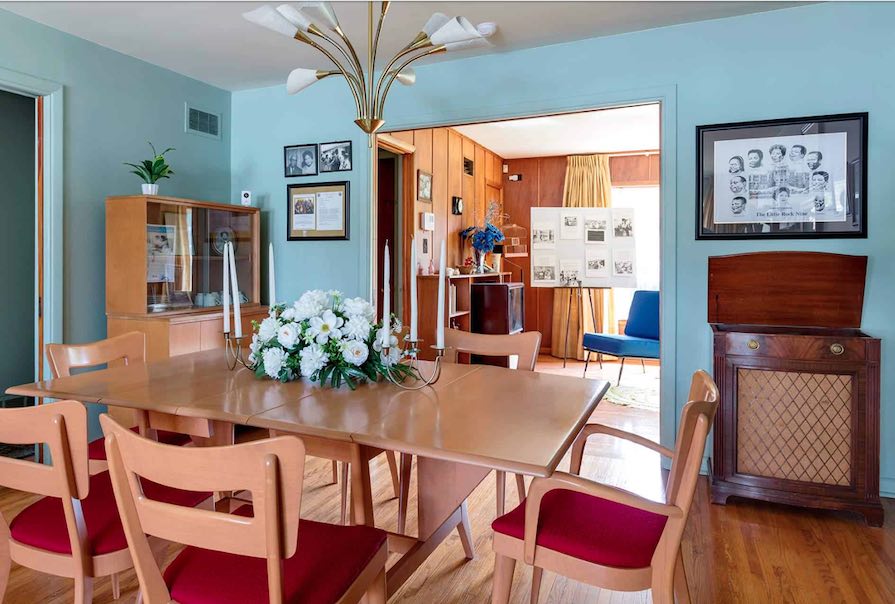
Little Rock Central High School National Historic Site stands as a huge symbol of the Civil Rights struggle for equal education and equal protection enforcing the 14th Amendment. After the 1954 decision on Brown v. Board the Little Rock Board of Ed. immediately refused to desegregate. Realizing this was an untenable stand, on May 24, 1955 they put forth a gradual integration plan. Their 3-phase plan would begin in 1957. Arkansas NAACP President Daisy Bates and the NAACP contested the plan. Nine Little Rock black students were chosen to become the first students in the then Central High School. The intimidating 7-floor, 2-block long, 1-block wide was built in 1927 and strategy and support meetings were held at the Bates’ home. Her home was repeatedly vandalized, bombed and the site of cross burnings. Tours can be arranged in advance. Her courage was honored with numerous awards and when she carried the Olympic torch on the Little Rock portion in 1996. 

The Nine first tried to enter on September 4, 1957 and were turned away. After several attempts to enter through shouting crowds, on September 25th President Eisenhower sent the Army's 101st Airborne and federalized the National Guard to escort them into Central High for classes. The school is the only functioning school within a National Historic Site.


Your first stop should be the visitor center and museum for background information. Ranger-led tours are available from there. Across the street is the gas station that was used by news services to tell the world.


The Little Rock Nine Memorial on the grounds of the State Capitol, “Testament,” depicts the nine students as life-sized bronzes. The diorama is positioned so that visitors can interact with the figures and are facing the governor’s office so that these events are kept in the forefront of their thoughts. #visitLittleRock

On June 11, 1968 Abbey Roads Studio produced a solo by Paul McCartney. The song, “Blackbird,” is a tribute to the “struggle in the southern states.” McCartney stated that the blackbird is symbolism for black girl.

Follow the Civil Rights Trail and be changed forever.

"For us, the bottom line was every single morning of our lives for nine months, we got up, we polished our saddle shoes, and we went to war." Melba Patillo Beals, one of the Little Rock Nine


Monday, April 1, 2024

Seeking Ghent’s Adoration of the Mystic Lamb


Seeking Ghent’s Adoration of the Mystic Lamb

                  Travel and a good tale in a single destination is a dream come true. Ghent, Belgium, owes its settlement to the fact that it is located at the juncture of the rivers Scheidt and Lys. The name itself is a form of the Celtic word “ganda,” meaning confluence. The first permanent settlement dates from 406 and by the Middle Ages it had grown wealthy from trade and textiles. 

                  Ghent is notable as one of the most historic and beautiful cities in Europe filled with architecture that will take your breath away and artistic treasures that are unique. Everything about Ghent is extraordinary, especially the manner in which the medieval and the modern blend and flow together seamlessly. Our search for Hubert and Jan van Eyck’s Adoration of the Mystic Lamb, and the stories surrounding it, will take us throughout the city and into some surprising places.

                   Our Ghent search is best begun in the Historium. There we embark on an experiential walk through a day in 1435 as seen through the eyes of one of van Eyck’s apprentices. Visitors walk through a series of galleries that spring to life with the aid of modern technology incorporating life-sized dioramas, sight, smell, sound and visuals. In Jan van Eyck’s studio we meet him, see how his workshop functioned and watch as he paints The Madonna of Canon van der Paele. A trip through the Historium gives you an idea of the era and how paintings were accomplished in the workshop of a master artist.

                  The Adoration of the Mystic Lamb, aka the Ghent Altarpiece, is actually the work of both Hubrecht (Hubert) and Jan van Eyck. Evidence proves that Hubert began the work and upon his death it was completed by Jan, at the 1432 request of Joos Vijd, and placed in a chapel in the Church of Saint John, currently the Cathedral of St. Bavos. It was dedicated on May 6, 1432 and this monumental polyptich was painted on oak panels with mineral pigments. Jan is best known as the artist who perfected the use of oil paints and this is considered his ultimate work. Internationally it is known as one of the most important artworks in the world, one of the first painted altarpieces and the most stolen.

 The work has been involved in no less than seven thefts because of its beauty and religious significance. Twelve panels depict Catholic beliefs, some from the Book of Revelations, starting with the Annunciation and proceeding to the adoration of the Mystic Lamb, symbolic of the blood sacrifice of Christ. Almost from the beginning the work was so famous that there was a fee to see it. 

The frames of van Eyck’s works, unlike other painters of the era, were signed and dated. A quatrain discovered on the frame in 1823 confirmed the fact that Jan completed the work after the death of Hubert. On the bottom of one panel there is a chronogram, words symbolizing numbers, that reveal the date the work was undertaken, May 6, 1432.

The Mystic Lamb was on view until 1566 when it was hidden in a tower to protect it from revolting Protestants. In 1794 the main panels were removed to Paris for Napoleon and not returned for 21-years. Some of the side panels were sold in 1816 and the remainder of this great artwork barely missed being destroyed by fire 6-years later and finally in 1920 it was reconstructed. 

         The trail and the tale become even more intriguing with the April 11, 1934 theft of two panels featuring "The Just Judges"and "St. John the Baptist.” A $1-million ransom was demanded and “St. John the Baptist” was returned as proof that the panels were really in this person’s possession. Shortly thereafter Arsène Goedertier, a stockbroker, suffered a heart attack and as he was dying he claimed to know where the painting was. The authorities found incriminating information but never located the “Just Judges.” 

The case is still an active investigation and the police continue to apply emerging crime solving techniques. In a macabre turn an amateur investigator disinterred Goedertier's skull in 1995 in order to hold a séance to gain information concerning the heist. 

                  During WWI neutral Belgium was invaded by Germany on August 4, 1914. They managed to resist for 11-days but were ultimately overwhelmed. Germany invaded the country again at the start of WWII on May 10, 1940. Hitler was set on obtaining the Ghent Altarpiece from the start of the war and in July 1942 he ordered that it be surrendered. It was secreted within the Reich awaiting its removal to Hitler’s planned Führermuseum containing art confiscated from the conquered countries.


                  The US created the American Committee on the Protection and Salvage of Artistic and Historic Monuments in War Areas in 1943. The Monuments Men and women were supplied with lists of stolen artworks to trace and return to the owners. In 1944 they were given photographs of the altarpiece and were informed that the painting was hidden in an Austrian salt mine. On May 12, 1945 they recovered The Mystic Lamb and more than 6,500 additional works. Because of its importance to the world in 1946 It was the first artwork to be returned. 


                  Located outside of the cathedral is Ghent’s 1913 homage to Hubert and Jan van Eyck. The sculptural monument is a carved diorama depicting a number of people gathered to pay tribute to the artists. The brothers are seated in the center with Hubert, the elder, reading the Bible with the tools of his trade at his feet. Jan looks forthrightly ahead while holding his palette and brushes. 

The Caermersklooster, Ghent Cultural Center, was originally a Carmelite friary that is now exhibition space. Both permanent and temporary exhibits are presented in the center. STAM, the Ghent City Museum’s highlights include a panoramic view of the city and a maquette of Ghent on a 1:1000th scale. The city’s story is told from the 1400s.

The Ghent Altarpiece has undergone damage, theft and restoration over the course of its 589-year history and in 2012 the Royal Institute for Cultural Heritage Museum of Fine Arts began a state-of-the-art $1.4-million-euro ($110-million) restoration. One panel was restored at a time and a replica was exhibited in its place. The work was completed in 2020.


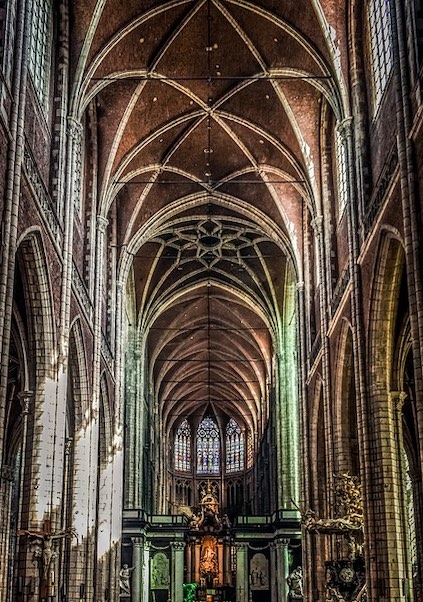
We have reached the end of our search. The Adoration of the Mystic Lamb is on exhibit, for a small fee, once again housed in St. Bavos Cathedral. The cathedral is not the first house of worship on the site. The earliest church dates from 942 but the earliest archeological evidence on-site is a 12th-century Roman nave that is within the crypt. The structure was started in the 1300s and was completed in 1559. It is virtually a museum of ecclesiastical art.

The 16.5-ft. by 11.15-ft. Ghent Altarpiece is awe-inspiring from the moment you enter the room. Audio guides are available and interpret each individual panel. Moving to the rear of the painting you can obtain a view of the additional panels that were only visible when closed. Of special note is the humanistic gaze of the lamb. There is limited seating for contemplation.


Ghent is charming by day but by night it becomes spectacular. The historic center is illuminated with special architectural lighting until midnight each evening giving the city a glow that will linger in your memory. #visitFlanders  #visitGhent


Unique Philadelphia Museums

“Follow your eyes to wherever they lead you…and the world should begin to change for you.”

                  The nine Muses were goddesses of the Ancient Greeks charged with inspiring those with all forms of artistic ability to attain ever more greatness. Their parents are Zeus, King of the Gods, and Mnemosyne, the Goddess of Memory. The basis for our current word museum is Museion, the place of the Muses.” Alexandria, Egypt was the site of the most renowned museion and the famed library.


                  The earliest, documented, public museum predates the Alexandrian structure by more than 1,000-years. In Ur, believed site of the birth of the People of the Book’s patriarch Abraham, 2,500-years ago Princess Ennigaldi-Nanna established a museum. She was a priestess who was in charge of educating the younger women and she founded her museum in 530 BC within the palace compound. The empire, and her museum, ended circa 500 BC. mymodernmet.com/ennigaldi-nanna


                  In 1925 English archaeologist Leonard Wooly located and began excavating the complex ruins and located some of the displays from the museum. Also unearthed were the world’s first museum labels. Ennigaldi-Nanna had curated the artifacts, some dating from as early as 2600 BC, with etched clay cylinders in three languages, describing the displayed article. Wooley is credited with excavating as many as 35,000 objects. 

                  Museums are commonly an outgrowth of an individual’s private collection that is gifted or bequeathed to showcase. Ennigaldi-Nanna’s father, Nabonidus, king and archaeologist and King Nebuchadnezzar II’s collections were the foundation of her museum. The Philadelphia museums in this article are the results of personal tastes and a desire to expose the public to what they love. Philadelphia boasts nearly 100 museums but the three highlighted should not be missed.


The Mütter Museum of medical history, part of the College of Physicians of Philadelphia, was established with an 1858 donation from Dr. Thomas Dent Mütter. It was initially on Locust Street but was relocated, with original display cases, in 1909 to 19 S. 22nd Street. Mütter was the chair of surgery at Jefferson College and pioneered both plastic surgery and the use of anesthesia. He died at the age of 48 and gifted his massive collection of antique medical tools, models, anatomical specimens and bodies, along with $30,000 ($1,135,339.02) to erect and maintain a building, to the College of Physicians. The museum was only accessible to medical professionals until the 1970s when the public was allowed entry.

The museum is internationally famous. Highlights of the exhibited collections are slides of Einstein’s brain, an 8-ft. long and 29-inch around colon, 139 human skulls, the death cast of Siamese twins Chang and Eng and President Grover Cleveland’s jaw tumor. The collection has grown to 25,000 artifacts.


The Native American Graves Protection and Repatriation Act (NAGPRA) mandates that federal agencies and institutions return Native American “cultural items” and bodies to descendants and tribes. The Mütter is in the act of returning some remains and examining their current ethical responsibilities. Muttermuseum.org


Philadelphia’s Jules E. Mastbaum’s admiration of French sculptor Auguste Rodin resulted in an unparalleled collection of his works displayed in the sole Rodin Museum not in France. Mastbaum, after making a fortune in cinema, became a serious art collector. Between 1924 and 26 he purchased more than 200 of Rodin’s works, some of which were cast personally for Mastbaum. Eventually his collection would include drawings and small pieces. In 1926 he requested permission to build a museum for the public from Fairmount Park Conservancy and received land on the Benjamin Franklin Parkway. He hired architects to build a museum that blended art and the natural landscape. It opened on November 29. 


There are approximately 150 works in the Rodin collection. Featured pieces include The Eternal Springtime, Young Mother in a Grotto, Sorrow and The Thinker. The real museum showpiece is the first bronze casting of Rodin’s 37-year project, The Gates of Hell a, 20 feet 10 3/4 inches × 13 feet 2 inches × 33 3/8 inches pair of doors, depicting the human condition with more than 200 figures, is beyond striking. Rodinmuseum.org

Albert C. Barnes was born of a poor family and worked his way through the University of PA Medical School. While working as a researcher he and a partner created Argyrol, an anti-infective that made him wealthy by age 35. He bought out his partner in 1908 and as owner he integrated the workforce by race and gender, shortened his staff’s workday to 6-hours and added a voluntary educational component. Two-years later he sent two men to Paris to collect paintings. They returned with 30 paintings. He continued to collect and was the first collector to amass African works as art and not utilitarian cultural icons. He was deeply involved with the Harlem Renaissance and African American art.


He opened the Barnes Foundation in 1925 within a purpose-built neoclassical mansion with an arboretum in suburban Philadelphia. His collection grew to include Native American, American, European art as well as furnishings. His arrangements, he referred to as ensembles, of artworks blend cultures, style, genres, colors and shapes in order for viewers to connect with the art in a variety of ways. He died in 1951 and left behind his foundation and a number of rules to govern its management. No works in the collection were to be copied for retail use, the number of visitors was limited and no work was ever to be moved from its original gallery placement.

The city immediately set out to take ownership of the $25-billion collection. They moved it to a 4.5-acre site in Philadelphia. The original Barnes was replicated at the heart of the larger foundation. All of the galleries are as they were originally and no object is more than 1/2-inch from its former placement. Among the 4,000 rare artworks on display are 179 Renoirs, 69 Cezannes, 59 Matisses. Highlights not to be missed are “The Bathing Group" (Renoir), "The Dance" (Matisse), "The Card Players" (Cézanne), “The Postman” (Vincent van Gogh) and “Redheaded Girl in Evening Dress” (Modigliani).


                  Currently a special exhibition, ALEXEY BRODOVITCH: ASTONISH ME, is on view until May 19, 2024. Brodovitch was a graphic designer, instructor, illustrator, and photographer who greatly influenced the art world. @barnesfoundation