Thursday, March 17, 2022

Experience Southeast Texas 


Native Americans settled along the shores of Sabine Lake in what was to become East Texas more than 1,500-years ago. In 1528 Spanish explorer Cabeza de Vaca and three of his men, including Estevanico an African, became the first Europeans to travel into the interior of Texas. They were followed, nearly 200-years later, by transient Spanish, French and Englishmen. In the 17th-century the lake became a draw for traders of legal and illegal goods, settlers and pirates like John Laffite. 


Some settlers moved from the southern states to SE Texas to establish plantations. They brought their slaves with them. By 1860 25% of Texas families owned slaves, usually fewer than a dozen. The largest slaveholder held 300 people in bondage. Free blacks were discouraged from living in Texas by an 1840 law stating that any free black caught attempting to enter Texas would be captured and required to post bail. Failing to do so would result in one year of enslavement. At the end of the year continuing not to post bail he would result in lifetime enslavement. Free blacks already residing in Texas were given 2-years to leave or the 1840 law applied. 


The region generally remained sparsely settled until 1840 when a community named Aurora was settled. Aurora failed but in 1895 Arthur Stillwell, a railroad entrepreneur, founded Port Arthur. Stillwell created the Port Arthur Channel and Dock Co. opening a channel to the sea in 1899 and precipitating an influx of colonists and businessmen. Spindletop Gusher in 1901 jettisoned Port Arthur into a new era. Large petrochemical companies moved to the city and it quickly became an international hub for oil refining. The Port of Port Arthur is 19-miles from the Gulf of Mexico and has the ability to handle both civilian and military cargo. 


Situated on the Central and Mississippi Flyway migration routes, Port Arthur is a prime location for birdwatching. Spring Migration: March 1-June 15; Peak: April 19-May 7. Fall Migration: August 15-November 30; September 5-October 29. #birdportarthur


The nationally renowned Museum of the Gulf Coast should be your first stop in Port Arthur. This 2-story museum manages to completely capture the story of Southeast Texas. The 1st-floor displays the area’s history from prehistoric times. The 2nd-floor features the Music Hall of Fame and the history of the music and the artists of the Gulf Coast. A 125-ft. mural, the largest in the region, is showcased in the first gallery and should be closely examined.


The second level is a music lovers’ wonderland. A self-guided tour filled with 55” touchscreen audiovisual stations, interactive displays, sculptures, memorabilia and artifacts winds you through the history of Gulf Coast music and its incorporation of blues, Cajun, country, gospel, jazz, rock, soul, western swing and zydeco. Port Arthur is located 30-miles from Louisiana and is musically influenced by being a cultural crossroads. Nearly 100 musicians are showcased in the Music Hall of Fame. 


One of the most notable showcases contains the ‘Vest Frottoir” owned by Cleveland Chenier. He and his brother Clifton Chenier, “King of Zydeco”, created the metal instrument because they felt the washboard on a rope instrument that hung around the neck was heavy. It has the distinction of being the only North American created instrument.


The museum honors the life and legacy of Janis Joplin, a Port Arthur native.  The display includes an outstanding sculpture, personal items, photographs and a replica of her 1964, mural-painted, Porsche 356C Cabriolet. She originally paid $3,500 for the gray car and then $500 to add the mural, The History of the Universe, painted by an artist. It sold to a private owner for $1.76 million in 2015.


Janis was born here on January 19, 1943 in the city. A driving tour begins at the museum and includes 15 sites. Her birth home, childhood home and schools are on the route. Tour brochures are available in the museum.    


Westside was the city’s African American community that flourished during segregation as a self-sustaining neighborhood. Blacks entered the area from the rural surroundings, some descendants of the enslaved from area plantations, to find work.


The Varner-Hogg plantation, the oldest in the state, is located in Southeast Texas and is a State Historic Site. The plantation features the main house, slave cemetery and several outbuildings, including slave quarters that interpret the lives of those who lived and toiled there. Visitors can rent a cottage for longer stays. 


Stephen Austin granted 4,428-acres to Martin Varner in 1824. Varner, a Virginian, brought several slaves with him to help establish a farm and distillery. Ten years later he sold the homestead to the Pattons of Kentucky. They founded Patton Place Plantation. Their 40-60 enslaved workers built the plantation structures, house, sugar mill and their own homes, with bricks made on-site.
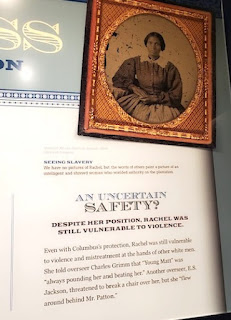


Columbus Patton, a successful sugar mill owner, openly lived with an enslaved woman he brought with him from Kentucky. Rachel was treated as the mistress of the house, had servants of her own and charged her clothing and accessories to the Patton account. She was well dressed and acted as a “white woman”. The family and community were outraged that they lived in “disgraceful intimacy” and in 1854 the family had him declared insane and removed to a South Carolina asylum where he expired 2-years later.


In his 1853 will he singled out 4 enslaved individuals, Rachel being one of them. She was to receive an annual income and the freedom to live where she pleased. His family contested the will and probate lasted until the 1870s. In the end Rachel was granted an annual payment of $3,205 ($109,555 in 2022) and freedom to move among Patton properties. By 1860 she had been persuaded to move to Cincinnati for the plantation’s morale but in 1869 she returned to the area. She is listed in the 1880 census as Rachel Patton, a 60-year old Black female widow. The plantation was sold in 1869.

The plantation museum features photographs, artifacts, oral testimonies and legal documents to enhance the story. 

A road trip through Southeast Texas is a unique experience you don’t want to miss!


#PortArthurTexas   #Varner-HoggPlantation   #MuseumoftheGulfCoast   #JanisJoplin


Wednesday, March 16, 2022

Virginia Beach, The First Resort


Native Americans, namely the Chesepians, inhabited the South Hampton Roads region of Virginia for thousands of years prior to first contact with English colonists on April 26, 1607. Three British Ships sent by the Virginia Company, sailed for 4 months, landed on Cape Henry and erected a wooden cross on the spot where they came ashore. Captain Christopher Newport, the first English tourist, was first to go ashore to reconnoiter and found “freshwaters, faire meadowes," and “goodly tall trees”. A second party built a small boat and visited the areas’ land and waterways. On May 14, the ships relocated to Jamestown and established the first permanent English settlement.


First Landing State Park commemorates the arrival of the first settlers, and in a way the first travelers who came to rest, rejuvenate and explore the Virginia Beach region. The African American Civilian Conservation Corps constructed the park from 1933-40, it is the most visited in Virginia and offers 20-miles of trails, 1.5-miles of Chesapeake Bay beach frontage and educational information. The park’s waterways have been roads for pirates, 1812 soldiers, Union and Confederate vessels and now recreational sailing.


Virginia Beach is astounding in its number and diversity of activities. The action is year-round and includes, whale-watching boat tours, eclectic dining, historic sites, 28-miles of oceanfront, 3-miles of boardwalk and a 30-block activity zone. It is the last estuary before the ocean and the bird watching is awesome. There are numerous choices regarding how you spend your time in this, the largest resort city in the world. Some are the traditional options and others have something a little exclusive for visitors to enjoy. 


It is no surprise that VA Beach is one of America’s most haunted cities because of its age and the number of deaths the city has witnessed. The current Adam Thoroughgood House is one of the oldest remaining brick houses in the country. It is located on the shore of the Lynnhaven River. The exterior brick forms an English bond pattern with 12-inch thick walls and tours are given of the exterior, restored and furnished interior and garden. 


Tours begin in the Visitor Center with a 7-minute orientation film. The original owner came over as an indentured servant. Once free he purchased land 5-miles from Cape Henry and brought over 105 other indentures, receiving 50-acres of land per person. His original estate was 5,000-acres and he later owned 27 enslaved Africans. The original owners haunt the house.


Grace Sherwood was a farmer, healer, midwife, widow and the sole convicted “witch” tried by water in the state. By modern standards Grace was harassed by her neighbors as she was chronically denounced as a witch for killing livestock, altering the weather, destroying crops, wearing men’s clothing when she worked, etc. She often sued her defamers and won judgments but that did not deter them. In January 1706 She was again accused of witchcraft and in July 1706 she was walked to a point on the shore of the Lynnhaven River, now Witchduck Point, where she was bound and thrown into the river. In the ordeal if you sank you were innocent, dead, but innocent. If you floated you were guilty and punished. Grace floated and was then taken to jail for seven years. She became known to history as the “Witch of Pungo”. She is said to haunt the Ferry Plantation House where her trial took place and where she is supposedly buried beneath a tree.


Governor Tim Kaine exonerated her in 2006. A statue of her stands near the place of her ducking. She holds a basket of rosemary as a reminder of her role as a healer. A headstone has been placed in the garden of Old Donation Episcopal Church.


The jewel in the crown of VA Beach’s collection of accommodations is the Cavalier Hotel. It was constructed atop of what was once a sand dune in 1927 at the cost of $2-million. The Y-shaped, 600-room property offered every possible amenity as well as an in-house stockbroker. Every major band and entertainer played in the ballroom and ten US presidents have been guests. In 1942 The Dept. of the Navy conscripted the hotel for use during WWII.  The government retained the chef and the soldiers boasted how good the food was.


The hotel fell into disrepair and received a $90-million renovation. Today it offers luxury accommodations, a stunning menu of amenities, the top four restaurants in the area, SeaHill, a 6200-sq. ft. world-class spa facility, the Tarnished Truth Distillery and a host of hauntings. The most famous spirit is that of Adolph Coors, the beer tycoon, found dead on the grounds beneath his window on June 6, 1929, believed to have been a suicide.


Edgar Cayce (1877-1945) is known as the “Father of Holistic Medicine”. He began doing health readings for people in 1901 and soon concluded that our health is intertwined with our mind, will and spirit. He completed 14,306 readings over 28-years, on a membership basis. These readings, prescriptions for a variety of health issues are archived and accessible at the Association for Research and Enlightenment (A.R.E.). The VA Beach compound includes a library of 90,000 metaphysical books, Cayce Visitor Center bookstore, Lecture Hall, Spa, Health Center and Meditation Garden. Daily tours are conducted at 2:30 PM. EdgarCayce.org


The East Coast Surfing Championships, one of the largest and second oldest events in the World Surf League, will take place over 8-days this August in five designated surfing areas. As home of the biggest East Coast surf event VA Beach will host 28 countries and more than 800 competitors with a top prize of $30,000. Additional activities include Surfers’ Healing, for handicapped surfers one week before the championship and a tent museum displaying curated artifacts throughout. 


Learn to Surf Camp will be held for those wishing to learn or improve skills and learn ocean safety and surf etiquette. WESLAINESSURFCAMP. COM


Visitors can experience the unique and unexpected in Virginia Beach, the first continually surprising resort city. visitvirginiabeach.com


Wednesday, March 9, 2022

Norfolk, Virginia, Home of the Brave

Native Americans inhabited the Norfolk region, in a settlement known as Skicoak, for thousands of years prior to the establishment of a European colony in 1636 and in 1682 Nicholas Wise sold 50 acres of riverfront property to the Virginia General Assembly to found Norfolk. Fifty years later it was the largest town in the colony. During the American Revolution the busy port, shipbuilding industry and transportation of goods made Norfolk a prime target for a British attack and on January 1, 1776 they destroyed two-thirds of the city. Citizens torched what remained to prevent confiscation by the British. The city was rapidly rebuilt and again established prominence as a port linking transportation between North and South www.visitnorfolk.com                 

Norfolk’s fortunes turned in 1855 when the Benjamin Franklin steamed into the harbor bringing with it Yellow Fever. By the time the epidemic ended 33% of the population was dead.  Six years later Virginia seceded from the Union with the political agreement of Norfolk. The battle between the ironclads, the Monitor and the Merrimac, took place in the harbor in 1862 and in that same year Mayor Lamb surrendered Norfolk to the Union. It remained occupied until 1870.

In 1917 474-acres were purchased at Sewell’s Point by the Secretary of the Navy for the establishment of a naval base. An air station was added and eventually the two facilities combined to become Naval Station Norfolk, the world’s largest naval station. Naval Base Station boat cruises are available. Reservations are recommended. https://www.navalbasecruises.com

Norfolk has developed a series of thematic, self-guided trails that make a comprehensive tour of the city manageable. Routes are designed around areas of interest, historic venues, sightseeing and activities. 

The Cannonball Trail offers 400 years of history and provides an excellent orientation. Begin with an overview in the Norfolk History Museum at the 1794 Willoughby-Baylor House. This free museum relates the city’s stories through use of artifacts, photographs and text. 


In 1862 the city was formally surrendered in Norfolk City Courthouse, now the MacArthur Memorial 3 building complex. This free museum’s highlights include MacArthur’s iconic hat, pipe, glasses and artworks and photographs. The memorial’s other areas include a library, archives and theater. The museum contains nine chronological galleries featuring significant periods of his life. The Rotunda contains the tomb of Douglas MacArthur and his wife. www.macarthurmemorial.org


Civil War Trails driving tour showcases 24 sites citywide with a focus on Fort Norfolk and the 1862 place, Ocean View, where President Lincoln landed to visit McClellan and remained to organize a military operation to take Norfolk. Fort Norfolk, the final extant harbor-front fort, was seized by the Confederates in 1861 and retaken by the Union in 1862. 

Some of the locations on the trails are listed as sites on more than one route and figure in numerous historic events. Waterways to Freedom intersects with the self-guided Underground Railroad Journey from Hampton Roads tour and the Trail of Honor. The story interpreted by these trails dates from the time of the colonists when slaves were imported from Africa into the region and were active members in the maritime trades. Slaves would go to Higgins’ and Wrights’ Wharves and clandestinely board ships traveling north.

On November 7, 1775 Lord Dunmore, Royal Governor of Virginia, issued a proclamation from a British warship, anchored near Norfolk, emancipating any slaves and indentured servants who would take up arms for the British Empire. Hundreds fled to the British lines and Dunmore named them the “Ethiopian Regiment”. Initially they defeated the patriots but evacuated the area in August 1776 for New York.

Prior to the Civil War Norfolk was a resale hub for slaves. Traders collected slaves here from the North and sold them deeper South. It is estimated that 21,000 enslaved individuals, including Solomon Northrup, were sent to New Orleans. 

A highlight of the Trail of Honor is the 1920 West Point Monument in the Elmwood Cemetery. It is dedicated to the African American veterans of the Civil and the Spanish American Wars. A life-sized bronze statue of William Carney crowns the monument. Born enslaved in Norfolk, he was the first African American to be awarded the Medal of Honor and is one of more than 100 men interred there. 


Nauticus, a complex featuring a thematic museum and science center is located adjacent to the Battleship Wisconsin, one of the navy’s biggest and final battleships built. The first half of the free museum relates 246-years of naval history through displays with detailed ships’ models, artwork, dioramas and artifacts. The complete story of the Ethiopian Regiment is showcased. The second portion of the museum has five sections and focuses on Vietnam with emphasis on the 1968 Tet Offensive. nauticus.org

Guided and self-guided tours of the 887-ft. Battleship Wisconsin are available. Visitors can follow the footsteps of Ensign Alan Dean, the first African American officer (1951- 53) to serve onboard the vessel, through the officers’ quarters, chapel, upper levels and sleeping quarters. The battleship was active from WWII until the Persian Gulf War in the 1990s.

Art is infused into the culture of Norfolk in a variety of ways. The Chrysler Museum of Art presents 5,000 years of artistic endeavors in 50 galleries and more than 30,000 artworks.  The Chrysler Family holds the largest collection of free glass in the world and the adjacent Perry Glass Studio offers tours, demonstrations and the history of the art of glassmaking.


The perfect accommodation for a visit to Norfolk is the Glass Light Hotel and Gallery. The hotel is within a 5-minute walk of the major attractions, shopping and dining. The historic 1912 structure is now a boutique hotel with fitness facilities, lobby bar, dining options and deluxe bedding, room amenities and unique decor. The hotel has a 2-story gallery displaying glass sculptures by renowned artists. www.marriott.com/en-us/hotels/orfav-glass-light-hotel-and-gallery

A Mermaid Trail weaves throughout Norfolk and combines the city’s main themes, art, sustainability, fanciful tales and an endurable link to the country’s maritime history. Follow in their wake for a wonderful experience.